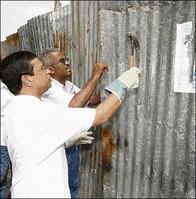
Badrul Haque (left), World Bank representative to Jamaica, is assisted by Claude Davis, technical officer for the zinc-fence removal project, in tearing down some of the zinc fences along Kidd Road in Whitfield Town as part of the project. The project is aimed at removing all the zinc fences in and around the Whitfield Town area and is carried out under the Jamaica Social Investment Fund Inner-City Basic Services Project, which is funded by the World Bank to the tune of US$29.3 million and the Government of Jamaica, US$3.5 million. - file
Scores of studies on Jamaica's crime problem have concluded that any attempt by the security forces to rein in criminals will be doomed to failure if there is not a corresponding move to attack the social problems facing the island.
Thousands of inner-city communities, with people living in squalor, unemployed, undereducated, young men hanging out on corners with easy access to guns, and an ailing justice system all combine to provide the wood that stokes the fire of violence which has resulted in more than 1,300 people murdered since the start of the year.
Successive administrations have accepted that social-intervention programmes are necessary but so far, those that have been introduced have enjoyed limited success.
Forming new crime groups
Shortly after being elected, Prime Minister Bruce Golding accepted the need for a coordinated social-intervention programme and pulled together a group to recommend a set of strategies for a "community resocialisation programme".
"A more collaborative programme is needed to drive a wedge between communities and criminals who do not necessarily enjoy the support of residents," Golding said at the time.
That echoed comments made more than four years earlier by Portia Simpson Miller who, at the time, was the minister of local government, community development and sports.
"Every time there is a challenge, we create new structures and organisations to deal with them, when we have ready organisations that, if we strengthen, have the capabilities to deal with some of the challenges," Simpson Miller said in an address to the national consultative committee on crime and violence.
But one year later, the People's National Party administration was to launch yet another social-intervention programme.
At that time, the security minister, Dr Peter Phillips, said the government would be fighting crime with a number of measures, including the recently launched Community Security Initiative, which had $200 million in funding.
"This should aid the social transformation of crime and violence-prone, gang-dominated communities into safe zones with legitimate social and economic processes; and also enhance the reach of public, social and economic services to poor, socially excluded communities, to strengthen their capacity to resist. However, despite the programmes and initiatives, residents - Canterbury in St James to Rema in south St Andrew and Rockfort in east Kingston - continue to suffer sporadic outbreaks of gang violence.
If there was any ray of hope, this was quickly seized on by Golding, who argued that certain aspects of government's social-intervention programme were showing positive effects in some communities, resulting in a significant downturn in crime statistics.
Decrease in murder rates
Referring to the Citizen Security and Justice Programme (CSJP) funded by the World Bank, Golding said he was particularly proud to report that the police crime statistics showed that in the Western Kingston Police Division, murder this year was down by 74 per cent. He said that in the West Kingston political constituency, which he represents, crime was down by more than 90 per cent.
Golding said it was important for the Government to find out the reasons behind the success and the failure of the CSJP, whichwas implemented in 15 Corporate Area communities.
These include Waterhouse, Tower Hill, Drewsland and Mountain View, which have all seen bloody conflicts despite the programme.
Against that background, Golding said he has instructed the Planning Institute of Jamaica to undertake studies in Fletcher's Land, Kencot and Matthew's Lane to determine the reasons for the success of the CSJP in those areas.
- A.H.
Social-intervention programmes implemented
USAID Grants Pen and Standpipe Lane intervention - 2000
Citizens Security and Justice programme - 2001
Flankers Peace and Justice Centre - 2002
Police Payne Avenue Intervention - 2004
Community Security Initiative - 2005
JSIF Inner-city Basic Services Project - 2006