Wilberne Persaud, Financial Gleaner Columnist
During the Financial Sector Adjustment Com-pany's (FINSAC) life, Parliament established a committee to consider causes of Jamaica's indigenous financial services meltdown.
Writing purely from memory, dates are fuzzy. I recall, however, that along with two colleagues from economics and management disciplinary areas at University of the West Indies, I went to Gordon House only to find committee members were no-shows.
We were summoned and, dutifully, presented ourselves at the appointed time to a chamber, empty, but for one senator.
That committee's remit made sense. I was happy, thinking in hindsight, perhaps unwisely, that we were, at last, copying a great thing from our powerful neighbour to the north - senate sub-committee hearings from which important, real, bankable information is had under oath.
Our current FINSAC Commission of Enquiry is entirely different.
We hear from enterprising Jamaicans who lost much, often all they worked for, risked for, yet have only scars to show.
Emotional tales
The Gleaner of November 26, 2009 narrates a movingly emotional tale of "participants in the ongoing commission of enquiry into the FINSAC (who) were left with heavy hearts yesterday as the hearing learned how the financial crisis of the 1990s and its aftermath ruined 59-year-old Mechesk Willis' life. All eyes fell on Willis as he ambled to the microphone on two crutches."
We deeply lament outcomes like these. We sympathise with those who genuinely lost their shirt.
Their credit risk officers and bankers must share much of the blame for these outcomes.
But, beyond that, note carefully, The Gleaner speaks of 'how the financial crisis of the 1990s and its aftermath ruined' Mr Willis. This turns out to mean FINSAC.
When we speak of 'financial crisis', as in 2+2 = 5, read 'financial crisis = FINSAC'. More correctly, read 'financial crisis + politics = FINSAC'.
The commission's title in Freudian slip, gives us clues. It is not to the indigenous financial meltdown that the commission addresses itself, but to FINSAC, the lifeguard called to duty.
Were FINSAC to buy the bad debt of every failed or delinquent borrower - that is, forgive or cancel all monies owed - that would be great.
Everyone would wish to be such a borrower.
Where would equity be? Those who postponed borrowing, did not lose their shirt, get nothing; those who did, reap great reward.
FINSAC was created to save Jamaica from mayhem that would follow loss of 60 per cent of all savings in the country; perhaps 90 percent of all life insurance policy contracts; and 75 per cent of all pension funds.
FINSAC prevented this eventuality at tremendous continuing cost. Now, if FINSAC was the disaster, as some thoughtful people have concluded - hence, the accused in the Pegasus dock - blow me over with a Hellshire Bay breeze!
Tougher questions please
Let me, again, indicate that I was a board member of FINSAC. Disclosure out of the way, the real questions remain:
| 1. | Why only locally owned and managed financial institutions went bankrupt?|
| 2. | Why were risky ventures funded with other peoples' money? |
| 3. | Why were hard-toiling migrant Jamaicans, working for over forty years in London, Manchester, Brixton and Liverpool, among other places, sold certificates of participation and commercial paper when they, perhaps stupidly, thought they were buying certificates of deposit to which no risk was attached? |
| 4. | We need to be told why merchant banks were allowed to move non-performing - that nice-sounding description as opposed to rotten, toxic and worthless - loans onto their building societies' books to hide them from regulators? |
| 5. | Why were so many of these loans given to related parties - companies wholly or nearly completely owned by the folks who owned the financial institution which extant legis-lation gave license to accept deposit money from unsus-pecting, ordinary Jamaicans? |
| 6. | Why after FINSAC, could Olint and Cash Plus have surfaced and prospered taking down unscrupulous lawyers and victim clients' funds, etc, with them? |
There are so many, many, more very real, remarkable questions. This commission should have truly mimicked US senate committee hearings.
Experts could have been brought in, forensic accountants who uncovered fraud, borrowers who claim lenders coveted their property, lenders who claim borrowers presented false documentation - all would have testified under oath upon pain of prosecution.
Apparently, this commission will not ask any of the real questions, so will not come close to real answers.
All I have read of its deliberations, so far, provides nothing but almost a smokescreen, compared to the really important questions ordinary Jamaicans should be given answers to.
It appears almost like a sideshow that will solve none of Jamaica's deep-seated economic problems, which I maintain are caused by anything but 'the economy', or interest rates.
The Gleaner's editorial thrust and Richard Byles of Sagicor Life Jamaica (formerly Life of Jamaica), one of our failed insurance institutions purchased by Barbadian capital, are today, actually saying this out loud.
Will our politicians, our leaders, listen? Can we make them listen? By the way, I commiserate with Dr Omar Davies on this one, not the 'run wid it', but he should remember the aphorism: 'no good deed goes unpunished'.
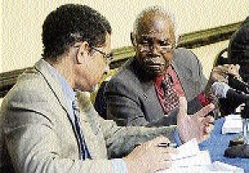
Commissioners Charles Ross (left) and retired Justice Boyd Carey confer at a sitting of the Finsac Commission of Enquiry, at the Jamaica Pegasus hotel on Tuesday, November 24. - File
wilbe65@yahoo.com