Robinson
Now that Ian Boyne has placed squarely on the table the issue of what a columnist's job description should be, it's time to put the issue to bed.
Boyne has built a career on other people's opinions and other people's lives. On 'Profile' he seeks to expose examples of the several paths to success taken by others and, in his regular Gleaner column, he has now admitted that proof of his scholarship is a priority over what it has taught him. In other words, he has translated Dudley Stokes admirable entreaty "You do all the reading that people don't have time for and tell us what the books and magazines say" into "make sure everybody knows exactly how many books you have read; list all the books that you have read that people don't have time for and encourage them to try to read them too if they think they bad!"
references important
As to what a columnist should do, Boyne writes, "As a reader, I would much prefer to know that the person I am reading has done the wide reading which qualifies him to write on a matter and that he has given me some references so I can do further work on my own, than to hear him sound off his own lazy, ill-conceived opinions. I can get that from any street corner. I would rather, in one column, hear many voices than just one. What about you?"
What about me? One voice is good enough for me, thank you very much. Some columns do depend on many voices, but are presented to the reader as a composite voice. Me, I would like to hear a personal view on the issues with source material cited only peripherally if it is important to substantiate a particular fact upon which that opinion is based. I am very cognisant of the fact that, one of the many hats worn by Ian Boyne is that of an employee of the Government's information services and it might be dangerous to his record of remaining in that field over different political administrations were he to express strong political views. But if that is what drives him, he should not have accepted the role of a columnist. Whether he likes it or not, a columnist is a talk-show host in writing without the hassle of immediate reply, but with all the other trappings including feedback (however delayed) from readers.
Readers of a column are looking for a personal touch. It is why Dr Stokes chose Boyne and not me. He wanted the Boyne perspective not a boring regurgitation of otherwise available material written from other viewpoints. The Boyne perspective might well be informed by the writings of others, but it cannot be that a columnist's duty is to read, absorb and vomit his reading on to the newsprint for recycled consumption as if all were a herd of bovines.
Boyne's scholarship
I readily concede that, if he has really read those books (we will never know, since real people just do not have the time or inclination to read only scholarly tomes), then Boyne's scholarship exceeds all who have come before him. It certainly exceeds my simple life experiences by street, lane and village. I'm a simpleton at heart and in fact so, when I have a linguistic difficulty (which is all the time), I head straight to that wonderful American invention, Wikipedia.
Wikipedia on columnists: "A columnist is a journalist who writes for publication in a series, creating copy that can sometimes be strongly opinionated. Columns appear in newspapers, magazines and other publications, including blogs on the Internet. Readers often open a publication with an expectation of reading a new essay by a specific writer who offers a personal point of view."
Why do you think that Ye Olde Editor insists on publishing Ian Boyne's photograph with his articles? It is to personalise them. Boyne again: "Whether I am writing about foreign policy, economics, politics, religion or public affairs broadly, my aim is to bring the best scholarship and thinking to bear on the issues. Scholarship should not be confined to recondite journals read by a few. My goal is to 'democratise' it and make it accessible to the masses. My own opinions are not the most crucial aspect of my writing, though I regularly make them known as regular readers can attest."
Ian, Ian, Ian ... your scholarship and how you achieve it is your business. However, if you want to bring the best scholarship to bear on the issues, you need to use that scholarship to help you to form a personal opinion. Boasting about your scholarship is not opinion writing. It is as tiresome and pedantic as boasting about one's "art collection, your antiques, your athletic abilities, your musical skills" or any other acquisition or achievement.
Boasting is NOT OK, Ian, not on any subject. It exposes insecurity and infers embellishment. And, on the subject of boasting, if you really want to "democratise" scholarship, you would have to stop using words like "recondite".
What I am saying here is that "democratisation" is not the columnist's task, it is a political mission. When columnists use words like "recondite" what they are seeking is to educate (which is fine), not democratise.
more than knowledge
I congratulate you on your interest in history and literature. It is admirable and is definitely the foundation upon which an excellent columnist is built. However, there is more to this thing than knowledge. Knowledge without personal experience is less than one half the journey. What the reader needs is the result of the addition of your personal experiences to your knowledge. It is this formula (knowledge plus experience) that results in wisdom. Each of us gains personal wisdom from our own experiences and has a responsibility to pass on that personal wisdom to the rest of the world which may not have had the identical experiences.
So, Ian, don't be afraid to show us who you really are (if you know the chap), how you really feel, what you really think. After so many years of telling us how much you really read, how much you really know, and how much you can easily repeat, your public is thirsty for more of you. Step up to the plate and take a swing, Ian. What's the worst that can happen, a strike out? The best hitters in the world strike out twice before each success at-bat. Don't be afraid to fail on occasion. I can tell you from many personal experiences that it's not the end of the world. It might just be the beginning of yours.
Peace and Love.
Gordon Robinson is an attorney-at-law. Feedback may be sent to columns@gleanerjm.com.
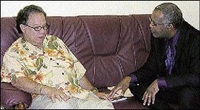
Ian Boyne and Professor Robert Hill.