
Robert Buddan - POLITICS OF OUR TIME
When the Supreme Court of India gave a verdict in 2007 that 11 'tainted' members of parliament (MPs) should be expelled from that country's parliament, it hoped the decision would be taken as a message to all legislators that "they have to be role models" and understand that their "conduct should be exemplary".
Jamaica's Parliament is in an unusual situation among parliaments around the world. It has been a busy year in which members of parliament have been faced with (1) eligibility and qualification matters in court in relation to the dual-citizenship status of two MPs and the potential for more, (2) corruption allegations against Joseph Hibbert, (3) corruption allegations against Kern Spencer and (4) an out-of-court settlement involving Colin Campbell, arising when he was a senator. In addition, there have been conflicts of interest of issues, such as those raised about a Government senator's interest in Urban Development Corporation land for a private institution that she heads.
In some cases, MPs themselves have been busy defending their colleagues in court, as Ernie Smith has been in the case against Hibbert and Senator K.D. Knight has been for Spencer. Even former MP Abe Dabdoub had been busy on behalf of himself and his clients, seeking to qualify for membership of Parliament in the cases against Douglas Vaz and Gregory Mair. At the same time, Senator Tom Tavares-Finson is defending a well-known private figure in an extradition case, which has great significance for the question of who is representing whom between constituency and Parliament, and what interests our system of parliamentary representation sometimes serve.
There are many inherent dangers. MPs can end up spending too much time defending or being defended to concentrate on their work as parliamentarians and constituency representatives. The reputation of Parliament and its membership could fall so low that voters lose trust and stop voting for them or believing them. The very legitimacy and stability of Government can come into question, making potential investors nervous. Our Parliament must redeem and renew itself. It is time for the introduction of 'House-cleaning' legislative measures in Parliament.
ethical issues
It is common practice in Westminster parliaments that parliament makes rules for governing itself. This applies to rules for ethics. There is an ethics committee of the Jamaican Parliament (to which Hibbert belongs, interestingly). The question becomes, how fully developed are its rules and how active is that committee? We also need to know what role is played by bodies such as the corruption prevention commission and the courts, in protecting the parliamentary system of honesty and fairness without which true democracy cannot stand.
We could empower the ethics committee to refer matters needing investigation to the corruption prevention commission and the office of the contractor general or to the police and for the court to decide on guilt or innocence. The ethics committee should also have the power to reprimand independently, suspend or expel a member, depending on the particular breach of Parliament's code of ethics and to suspend the member's immunities and privileges, as the case might require, for the person to go to court, give evidence, or go to jail. Persons should be suspended while an investigation or court hearing is going on and, if it becomes warranted, expelled after guilt has been established. Members of the ethics committee who are being investigated and those providing legal defence to those being investigated (such as Hibbert and Smith in the present) should recuse themselves from that committee.
Much of this accords with Westminster practice. I have heard it said that in Britain the system of honour is relied upon so that MPs resign rather than wait to be expelled. There is no such honour system. It has always been a myth. In Britain, Parliament has given itself power to expel and the court does not challenge that power. Parliament is supreme. But not so in Jamaica. The Constitution is technically supreme. Jamaica's Parliament should be allowed to investigate and suspend a member and revoke and strip membership if the court first proves the member guilty. British practice is not always best practice and there can, and should be variations within the Westminster tradition.
parliament as a court
Parliament can also act as a court and send members to prison. If this sounds contradictory, it is not. Since Parliament can make its own rules, it can make a rule that when members break the rules of Parliament (as distinct from the criminal and civil laws of the land), they can be subject to certain forms of punishment. Since, in Britain for example, parliament decides and defines what action it can or should punish, then the Jamaican Parliament can empower itself to do the same regarding parliamentary rules. And since, in Canada, the Senate and House can commit someone to prison for contempt of Parliament, then the Jamaican Parliament could make a rule to do likewise. The Indian precedent should, at the same time, always be followed, that being to recognise that even where Parliament's decisions deserve deference, its acts should be subject to judicial scrutiny.
The sad fact is that the Jamaican Parliament has fallen behind, ironic because there are so many lawyers in it. But the lawyers in Parliament can end up spending more time defending themselves and each other than in defending parliamentary integrity. Parliaments in India, Australia, New Zealand, Canada, the UK, Tanzania, Singapore, Zambia and Grenada have all suspended or expelled a member in recent times.
expelled Prime minister
In 1978 ,the Indian Lower House actually passed a motion to expel Prime Minister Indira Gandhi for breach of privilege and contempt of the House. In Bangladesh, a parliamentary committee recommended revoking the membership of a former speaker of the House for massive financial graft. The ethics committee of Canada's House called the former Prime Minister Brian Mulroney, before it to answer bribery allegations. This one is interesting because the Canadian Parliament has given itself power to investigate former MPs as well as current ones so that wrongdoers don't necessarily get away upon leaving or retiring from Parliament.
I don't mean to suggest that Jamaica has done nothing. We have done much - integrity legislation from the 1970s and corruption prevention commission, contractor general, election commission, access to information law, parliamentary code of conduct and ethics officers over the course of the 1990s into the turn of the new century. But we might consider strengthening all of these by adding an independent ethics commissioner and having the Opposition chair the ethics committee of Parliament.
The rule of law should begin with those who make the law to rule.
Robert Buddan lectures in the Department of Government, UWI, Mona. Email: Robert.Buddan@uwimona.edu.jm or columns@gleanerjm.com.

Kern Spencer
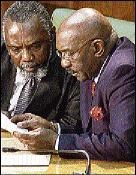
Joseph Hibbert with his lawyer and colleague Member of Parliament, Ernie Smith. - file photos