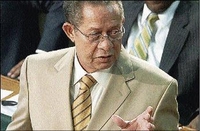
Prime Minister Bruce Golding. - File
A NUMBER of legislative commitments inked in the Jamaica Labour Party's (JLP) manifesto and verbalised on political platforms in the run-up to the 2007 general election are yet to materialise.
At the same time, some key proposals, which formed the central plank of the JLP's framework for good governance, have been introduced in Parliament, but the process to review and implement them is moving at a snail's pace.
In one of his first national broadcasts as prime minister, November 11, 2007, Bruce Golding said work was being fast-tracked on a number of the manifesto promises and appropriate legislation would be taken to Parliament "shortly".
However, two of the JLP's manifesto pledges that were heralded by Golding during the election campaign seem to have vanished from the radar.
In the election campaign, he gave assurances that if his party were elected, it would craft legislation to impose a two-term limit on anyone holding the office of prime minister, and establish a fixed-election period.
It is now nearly two years later, and the administration has failed to take legislation had to Parliament regarding term limits for prime ministers, or a fixed-election period.
For calendar year 2008, only two new pieces of legislation were passed by Parliament, with 16 existing laws amended.
The two new bills passed into law were the Pensions (Prime Minister) Act, 2008, and the Anti-Doping in Sport Act, 2008.
seven pieces of legislation
Up to July 2009, Parliament had passed seven pieces of legislation comprising two new measures, while the other bills amended existing laws.
The two new statutes passed so far this year were the Carriage by Air (Montreal Convention) Act, 2009, and the Jamaica Dairy Development Board Act, 2009.
Just before the summer break, the Senate approved the Child Pornography Bill, which is to be tabled in the House of Representatives for debate and passage.
A commitment to establish the Office of the Special Coroner was kept by the Golding administration, with Parliament giving the nod to an amendment to the Coroner's Act last year.
The JLP, in its manifesto, undertook to appoint a special coroner to conduct inquests in cases where persons had died under questionable circumstances at the hands of representatives of the State.
Towards the end of last year, the backlog of cases before the Coroner's Court numbered a little less than 700.
Of that number, 182 involved killings by members of the security forces.
Another pledge from the JLP was the setting up of an independent commission to investigate complaints of abuses by members of the security forces.
The Senate, in May, adopted the report of a joint select committee of Parliament, which deliberated for months on proposed legislation to establish the commission.
The Independent Commission of Investigation Act, 2009, when enacted, will repeal the Police Public Complaints Act.
That bill is listed on the Order Paper of the House of Representatives for debate and passage.
Special Corruption Prosecutor
A joint select committee of Parliament examining a bill to create the Office of the Special Prosecutor for Corruption to investigate acts of corruption in the public and private sectors is in its final stages of completing deliberations and should be submitting a report to Parliament shortly.
The establishment of a special prosecutor was one of the key legislative initiatives the JLP trumpeted in the run-up to the 2007 general elections.
Strengthening of the role of Parliament was a critical component of the JLP manifesto, which was fulfilled with the appointment of Opposition parliamentarians to chair special select committees.
increase the membership
Another proposal set out in the JLP policy document to increase the membership of the Senate to include representatives of civil society has, to date, received little or no attention from the administration.
In terms of appointments to sensitive posts, the JLP had proposed in its manifesto that it would push for a two-thirds majority in both Houses of Parliament to approve appointments to pivotal positions, such as the director of public prosecutions, the public defender, the contractor general and the chief justice.
However, the legislative process to fulfil this pledge is yet to be set in motion.
The Golding administration has taken action in its quest to reform the libel laws, with the appointment of the Justice Hugh Small Committee in November 2007, which reviewed the existing legislation and made recommendations.
Meanwhile, one year after the Government introduced six anti-crime bills, they are yet to be debated.
After the bills were tabled in Parliament in September 2008, they were referred to a joint select committee of both Houses for consideration.
edmond.campbell@gleanerjm.com