
Robotham
IT FEELS like an eternity but it is actually only two years that the Golding administration has been in power. Whatever their intentions, it is now clear that the success or failure of this Jamaica Labour Party (JLP) Government will be determined by one issue and one issue only: the fate of our economy.
When the JLP first came to power in September 2007, the political and economic climate was very different from what it is today. The People's National Party (PNP) had been in power for seventeen years and had clearly lost its focus. Issues of corruption cast a long shadow over the governing party and led many to conclude that it was time for a change. In addition, major reservations existed about the leadership of Mrs Simpson Miller. Nevertheless, there were strong concerns about the social-racial character of the JLP's leadership and what their coming to power might mean for Jamaican society as a whole.
The upshot was that the JLP barely squeaked home. The JLP won 50.18 per cent of the popular vote to the PNP's 49.82 per cent. This was a difference of just under 0.4 per cent —in absolute terms a mere 2,940 votes. If 25 votes per constituency had shifted to the other side, the PNP would have won the popular vote. Forty per cent of the electorate did not vote for either party. The JLP vote was 30.3 per cent of the total electorate. The PNP obtained 30.1 per cent. Neither side was able to obtain the support of as much as one-third of the electorate.
Neglect of the economy
After it came to power the JLP pursued a strategy of focusing almost totally on the corruption issue. Month-in, month-out, all one heard about was Trafigura and the Cuban light bulb affair. The two critical issues facing the country -crime and the economy - took a back seat, as the JLP sought to keep the Opposition on the back foot. The PNP countered with its own idiotic opportunistic strategy: the ridiculous dual-citizenship challenges which have now completely backfired.
Although they cannot be held responsible for the global economic crisis, these negative approaches by both the JLP and PNP led to a serious under-estimation of the economic challenges facing the country. Perhaps the clearest and most embarrassing expression of this was Finance Minister Audley Shaw's Budget speech of 2008. Speaking just four months before the biggest economic crisis since the Great Depression hit, he made the following assessment of our economic prospects:
"The risks to the macroeconomic programme projections largely emanate from the possibility of sharper than anticipated increases in international commodity prices (including oil prices), adverse weather conditions, and a recession in the USA.
"Simulations show that Jamaica's GDP growth would not be significantly affected and the external accounts would improve marginally in a scenario where a recession in the US lasts for two quarters only. The correlation between Jamaica's economic performance and the US business cycle has not been strong and the sources of the main financial flows, tourism and remittances, have become less sensitive to these business cycles. Inflation could be lower by approximately 1.5 percentage points, relative to the baseline, depending on the impact of the lower global demand on commodity prices."
In other words, as late as April 2008, Shaw put forward the view that not only had Jamaica's economy "become less sensitive to these business cycles" but that a recession in the United States could actually cause our economic situation to significantly improve!
Now that the absurdity of such a viewpoint has become obvious, the Government is scrambling all over itself to get money from the International Monetary Fund. Whatever such an agreement may achieve, it is clear that, after two years in charge, the Golding Government has yet to come to grips with the fundamental economic problems facing the country.
Crime
The same applies to that other critical area - the area of homicides and crime in general. We are now into our third minister of national security in two years, and homicide rates continue to be high. Some headway has been made in tackling the most outrageous cases of police corruption but no breakthrough has occurred or is likely to occur. The much heralded 'crime plan' - promised in the first flush of the Trevor MacMillan appointment as national security minister - has vanished without a trace.
The tendency for crime to spread from the Crporate Area and St Catherine to rural areas - especially in Clarendon and St James - continues unabated. Indeed, as the economic situation continues to deteriorate, property-related crimes have soared, as has ganja cultivation and trans-shipment. The crisis of our youth which is the root of our crime problem continues to intensify. Youth unemployment remains over 20 per cent, with at least 300,000 persons in the 15-29 age group unemployed. Moreover, of those who are employed, at least 100,000 belong to the working poor, those who at best get the minimum wage, have no pension, housing trust or health benefits and work very long hours with no job security.
Despite solid progress in areas such as early childhood education, the performance of our adolescent youth in English and math remains abysmal. The wonderful victories of our athletes in Berlin notwithstanding, the prospects for the majority of our youth are not bright. Thus, it is a certainty that high homicide rates will continue to be a feature of the Golding Government for the rest of its term in office. The Jamaican people have concluded fatalistically that they are on their own where security matters are concerned, and each person simply has to fend for himself/herself.
Personnel problems
Faced with the intractability of these problems, the tendency has been for the Golding Government to place the blame on the shoulders of various personalities. Indeed, from its inception, the Government has become entangled in one imbroglio after the other in the personnel sphere. First it was the prolonged Stephen Vasciannie affair which was swiftly followed by the on-again-off-again resignation of Commissioner of Police Hardley Lewin.
The latest episodes in this drama concern the upheaval in the upper levels of the Ministry of Finance, the reshuffling of permanent secretaries and the summary dismissal of Robert Gregory as head of Jamaica Trade and Invest. Combined with this seeming inability to form a stable management team, both politically and administratively, the JLP government, and Golding in particular, has a tendency to resort to provocative remarks. Hence the quip about 'termites' and the recent gratuitous assault on the teachers and police officers by the prime minister at his post-Cabinet press conference last week. These are essentially public expressions of frustration and convey the impression of a leadership lacking in self-confidence.
No alternative
Yet, all these negatives notwithstanding, the Golding Government is still the only show in town. The PNP remains in disarray, unable or unwilling to resolve its leadership crisis. On economic policy, Shadow Finance Minister Dr Omar Davies has effectively exposed the incompetence of the JLP financial team, but has yet to put forward a comprehensive alternative to current economic policies.
In the area of national security, Peter Bunting is beginning to assert himself but the issue is not self-assertion but the development of convincing solutions to our security crisis. The same can be said about the performance of Basil Waite in education: he has presented some good ideas, but they are very far from a comprehensive set of alternative policies. All the PNP chatter about 'the Progressive Agenda' remains just that —nuff chat!
So, we seem to be stuck with Golding by default. The difficulty is that the grave problems of Jamaica require a leadership capable of mobilising the population in an unprecedented united effort. Enough time has passed for us to conclude that Golding is unable to provide that quality of leadership. Nor can anyone in the PNP. So we soldier on, sheep without a shepherd!
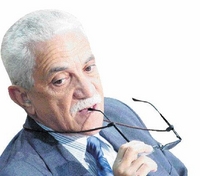
Trevor MacMillan ... one of three national security ministers in two years. - file