
Sandra Watson, Guest Writer
The Registration (Strata Titles) Act became operative on August 22, 1969. The first Strata Plan - Strata Plan No. 1 - was registered by the registrar of titles on April 2, 1970.
Up to February 12, 2008, some 2,372 strata plans had been registered. In this system of land ownership, the proprietors of the strata lots identified in a strata plan become a corporation designated in law as The Proprietors Strata Plan No. ... .
Weaknesses noted in the management of strata corporations over the years of operation of the act include absence of annual general meetings of proprietors; non-appointment of executive committees; non-payment of contributions by proprietors for the maintenance of common areas; and non-payment of insurance coverage annually.
There has also been a lack of estimates of expenditure, for presentation to every proprietor, on the basis of which maintenance of common areas is calculated; and non-compliance with by-laws, which define the rights of proprietors and the responsibilities of strata corporations in the administration of the common property.
Government, therefore, decided that the law should be amended in order to address these concerns.
The bill - titled 'An Act to Amend the Registration (Strata Titles) Act' - tabled in Parliament in July, is the result of an exhaustive consultation and review process.
One of the most important reforms is the proposed establishment of the Commission of Strata Corporations.
Strata corporation defined
The strata corporation is a legal entity with all of the powers of a natural person who has full capacity. This means that it can sue others, be sued by others, enter into contracts with others, and hire employees.
The owners of the strata lots referred to as proprietors in the act are the members of the strata corporation.
If a strata corporation is responsible for paying a judgement, the owners are personally liable to pay a portion of the judgement in proportion to their unit entitlement.
A strata corporation does not have limited liability like a company.
It is responsible for managing and maintaining the common pro-perty and assets of the strata corporation for the benefit of all of its owners.
DECISION MAKING
Decisions of the strata corporation are made by either the eligible members, or the executive committee.
The law may require that a matter be resolved by a unanimous vote. These decisions must be made by all the voters in the strata corporation. These issues are mainly concerned with property rights and insurance.
The act may also require that a matter be resolved by a majority vote of the strata corporation, for example, approving a budget, directing or restricting the executive committee, and ratifying rules. These decisions must be made by more than half of all the eligible voters who are present in person or by proxy at a general meeting, and who have not abstained from voting;
Any matter that is not required by the act to be resolved by a specific vote of the strata corporation can be resolved by the executive. These decisions usually relate to the daily management of the strata corporation.
Strata corporations are democratic, and run on democratic principles, equal voting, election of representatives, majority rule - through a simple majority vote unless otherwise stipulated by the law, and the right to raise issues.
Owners can add matters to an extraordinary general meeting agenda if they can get persons holding 25 per cent of the votes to agree to it. They can requisition an extraordinary general meeting for a particular purpose if they can get persons holding 25 per cent of the votes to agree.
COMMUNITY INTEREST
A strata corporation creates a community of strata owners. The right of an owner to use and enjoy his or her property will be limited by rules, bylaws and decisions of the strata corporation, which are in the community's interest.
The obligations and limitations placed on a strata lot owner may be significantly greater than an owner who lives in a non-strata titled house. For instance, strata lots may be separated by interior walls, floors, and ceilings that are just several inches thick, and the strata corporation may have bylaws which are intended to control noise, such as a bylaw prohibiting the installation of hardwood flooring.
And, a roof may be in need of repair, but an owner wishes to put off the repairs, as he or she cannot afford to pay his or her share of the repairs. The strata lot owner may have no choice but to pay the special assessment for the repairs, as getting the roof fixed is in the community's interest and an obligation of the strata corporation.
REFORM PROPOSALS
To establish a Commission of Strata Corporations and to specify the duties of that commission to provide administrative oversight.
To provide for the keeping of a register of strata corporations as a means of collating information on the strata corporation.
To provide for the application of fees collected by the commission to its administrative expenses.
To provide for the mandatory registration of each corporation with the commission.
To mandate the submission of annual financial statements and reports by each corporation to ensure that strata corporations are operating in compliance with the act.
To provide that where a corporation defaults on payment of premium on a policy of insurance which lapses or is cancelled, the corporation shall inform the proprietors and mortgages, if any, of this fact.
To create an implied covenant between a proprietor and a corporation that the proprietor or his heirs will pay any outstanding charges owed to the corporation prior to a transfer.
To provide the procedure to be followed where a proprietor fails, neglects or refuses to pay contributions to the corporation.
To allow a power of sale to be exercised by a strata corporation for non-payment of contributions to the corporation by a proprietor, (this process cannot be concluded unless contributions are outstanding for a period in excess of 90 days) and to provide for the application of proceeds of such sale.
To provide a copy of the by-laws of the corporation; and an address for services for each proprietor.
To establish a strata appeals tribunal.
To widen the regulatory powers of the minister to prescribe the manner of registration of corporations and the matters that are to be communicated by developers of strata lots to prospective purchasers.
To provide for the corporation to fix the rate of interest to be charged on arrears of contributions.
To enable the commission to also apply to the court regarding the appointment of an administrator for a strata property.
To increase the penalty for certain breaches of the act.
With the tabling in Parliament of the bill, it is expected that there will be a robust debate on its content. The proposals are constructive for solving the management problems facing strata corporations.
Sandra Watson is general manager of the Real Estate Board.
swatson@reb.gov.jm
Specific duties and obligations of the corporation and executive committee:
To appoint an executive committee by proprietors at the AGM consisting of no less than three nor more than nine proprietors.
To insure the building, subject of the Strata Corporation, at replacement value against fire, earthquake, hurricane, unless the proprietors by unanimous resolution determine otherwise.
To establish a fund sufficient to cover management expenses.
To determine from time to time the amounts to be raised for the fund by levelling contributions on the proprietors in proportion to their unit entitlement.
To recover from proprietors any money spent by the corporation for repairs to the common property.
Preparing, retaining and making accessible various records.
Holding annual general meetings and extraordinary general meetings to settle issues which may arise from time to time.
Paying common expenses
Maintaining and repairing common property, except any limited common property that the owners may have to maintain under the by-laws.
Preparing annual budgets
Determining the amount of contributions which owners must pay to the operating fund and the contingency reserve fund annually.
Giving notices of meetings
Informing owners of any changes to strata fees.
Informing owners if the strata corporation is sued.
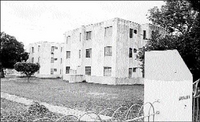
Avalon Court, a strata scheme bedevilled by unpaid maintenance fees.- Norman Grindley/Chief Photographer