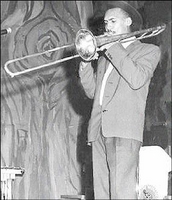
Expert musicians of the time, such as Don Drummond, pictured here, all looked up to Wilton Gaynair. - File
It seems we here in Jamaica have a certain difficulty getting past Bob Marley and his vast musical achievements to pay attention to others, especially if they are not musicians who perform in the popular music and reggae styles.
Jamaica's Alpha Boys School is known for graduating first-rate musicians. Tenor saxophonist Wilton Gaynair (born January 11, 1927 in Kingston, Jamaica - died in Germany, February 13, 1995) was no exception. The Alpha experience is a commitment that was evident in the underexposed Gaynair, who merits special attention from anyone who is serious about jazz.
His playing is as rewarding as that of many better-known horn players. With a full-bodied tone, even touch and a mellowness of sound that lingered on the finish of his notes. Gaynair was accorded the respect and admiration of countless jazz musicians who encountered him. His playing was bold, distinct, and purposeful on medium and up-tempo material, warm and melodic on ballads. In either style, he was delightfully lyrical.
deep sonorous sound
A superb technician, with a heavy, soulful thrust, Gaynair prided himself on making each performance diffe-rent from the last. He was cut from that special 1930s and 1940s brand of saxophonists that included Chu Berry, Don Byas, Lucky Thompson and Hawkins. He also had that same deep sonorous sound like they did. It was a sound that was as invigorating as a well-balanced tropical rum punch, and as luscious as a fruit-filled black pudding, with a hint of Eddie 'Lockjaw' Davis thrown in as spice. The sound was complemented by elements of swing, hard bop and subtle blues. These are the flavours that defined Gaynair's tonal quality.
I first became aware of Wilton 'Bra' or 'Bogey' Gaynair as soon as my interest in jazz was noticeable to the more advanced converts to whom I had access. My father, being the chief source of my information, took pride in letting me know, back in 1963, that Jamaica had produced outstanding international jazz musicians. It was also about that time that I first had the opportunity to hear Wilton Gaynair's recording Blue Bogey, and while still getting grounded in the basic language of jazz, I became a convert to Gaynair's music.
Blue Bogey is a seminal recording. It is important because it not only allows us an examination of one of Jamaica's most accomplished musicians, nor is it because it is jazz played at a level any well-known saxophonist would be proud to claim. More important, this recording helps to fill a huge gap in the chronological history of popular Jamaican music during the formative years. The period between jazz, and its transformation through Count Ossie's Nyabinghi music to ska.
conceptual sensibilities
Blue Bogey allowed us to appreciate the level of musicianship and the conceptual sensibilities of players like Joe Harriott, Dizzy Reece, Sonny Gray, and Harold 'Little G' McNair, players that preceded luminaries of Jamaican popular music like Tommy McCook, Roland Alphonso, Johnny Moore, Ernest Ranglin, and Don Drummond. The latter set all looked up to Gaynair for leadership, both musically and socially.
For them, not only was he a master of the art, but also, it came in the way he dressed and his presence, the way in which he carried himself, which were marks of distinction. Based on the conversations with McCook, Alphonso, and guitarist Janet Enright, the influence Gaynair had on Jamaican musicians of the time can't be overstated, and, you couldn't ask for a better representation of jazz on the island than at that moment. Such is the regard Sonny Bradshaw had for 'Bra'.
Gaynair was our saxophone idol. After receiving new songs he would say to me "let's go to the garden (Bournemouth Gardens) and play". For example, he would say "Come let's go practise the bridge on Body and Soul". He was what we called in those days a Beardman; (a Rastafarian) he kept a picture of (Haile) Selassie in his sax case but did not wear locks or anything like that. He was, also, never one for angry expression, at least, not in my presence. He was a neat dresser at all times, not a fancy dresser, a gentleman nontheless. The continental suits and ties came with his residency in Europe.
- Sonny Bradshaw
This article is from the archives of the Jamaica Music Museum
For further information contact: Institute of Jamaica, 10-16 East Street, Kingston
Telephone: 922-0620-6 Email: helpdesk@ioj.com. website: www.instituteofjamaica.org.jm.