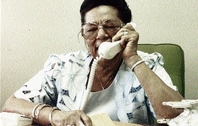
Long before she became 'Lady B' Gladys Longbridge enjoyed playful days in Ashton, Westmoreland, where she was born on March 8, 1915, to Frank Longbridge, a planter, and his wife, Rebecca.
As an infant, she was entrusted to the care of her grandmother, Mary Blackwood, and an aunt, Rachael Blackwood.
Her childhood was a happy one spent in the company of her extended family. Indeed, her grandmother exerted a strong influence on young Gladys, instilling in her the love and fear of God, and concern and respect for her fellowmen.
Having mastered the 'baby' books provided by her aunt and grandmother, she was placed in the second primer rather than the bottom grade at the one elementary school which the village boasted.
She applied herself to subjects, such as English, scripture, arithmetic, and Bible studies, eventually completing the Second Jamaica Local Examination.
love for the church
At this time, 'Miss G', as she came to be called, having learnt to play the organ, provided the accompaniment for Sunday services at the Ashton Moravian Church.
This love for the Church and involvement in its activities she carried with her to Kingston, when she started studies at Tutorial College on Duke Street in 1932.
Here, 'Miss G' became proficient in shorthand, typewriting and bookkeeping. These subjects became her favourite and were to stand her in good stead.
While at Tutorial, she made the acquaintance of people like Wesley Powell, founder of Excelsior School, and Alvin S. Henry, founder/principal of Durham College of Commerce.
Having completed her schooling 'Miss G' returned briefly to Ashton before moving to Kingston in early 1934.
She started working at Arlington House, a hotel-restaurant on East Queen Street, where she was employed to act for a secretary who was then on sick leave.
Arlington House patrons included members of the then Legislative Council and those who wished to lobby them, such as journalists and aspiring politicians.
It was here that her acquaintance with Alexander Bustamante developed. He frequented the establishment for dining, as well as to indulge in exchanges with the politicians and journalists.
'Miss G' had, in fact, first met him while on her way to Sunday service. They were to meet again when she started working as his secretary in March 1934.
As Lady B reminisced, "Working for him was hard, because he never let up. He would begin early in the morning, and continue till very late at night, but I found the work challenging. I learned to work long, hard hours, which came in very useful later."
pure gold
Sir Alexander on his part, later said, "When I met Lady B, I struck pure gold." Thus began her career as private secretary, aide, adviser, supporter and defuser of volatile situations.
She travelled around the countryside, acting as navigator as they visited obscure villages, sharing with 'the Chief' the hardships, discrimination, resentment, and even violence, directed at them on occasion.
"Many days, we had saltfish and crackers for breakfast, saltfish and crackers for lunch and dinner too. And we ate plenty dust on those unpaved roads. We carried our own water with us because the water supply wasn't good in those days ... And Lady B - she was Longbridge then - never complained. A slender little girl she was then," Bustamante later said.
During World War II, Bustamante was detained under the Defence Regulations Act and Miss G was his only contact with the then recently formed Bustamante Industrial Trade Union (BITU).
After 17 months in detention, Bustamante was released and he recorded his appreciation of Miss Longbridge's support during this crisis.
"Without Miss G, the union would not have survived this incarceration, and I owe all my success to her."
Later, when the Jamaica Labour Party (JLP), was formed in 1943, Miss Longbridge was made a trustee, a position she held up to her death.
Her support and work for Bustamante continued as she became involved in political campaigning with him.
Journalist Evon Blake, writing in the August 1953 issue of Spotlight magazine, had this to say about Miss Longbridge's work: "It took courage beyond and above the call of duty to mount the hustling in those early days of political rough-housing.
"The country-bred girl who played the organ at Sunday School in the little Moravian chapel at Ashton, Westmoreland, grew into an owl-wise public relations expert and political strategist, whose sharp-eyed knowledge of the right street corner to hold party meetings was much in demand; whose memory for names and faces of hitherto obscure workers was invaluable to the young BITU and JLP, and the naturally impulsive leader."
leasure in victory
Being involved in Bustamante's political career, she took pleasure in his victory at the polls in 1944, rallied behind him after the defeat by the People's National Party in 1955, and later celebrated his victory in the elections which marked the creation of the short-lived West Indies Federation in April 1958.
Bustamante's contribution to the attainment of nationhood was recognised by the British government through a knighthood conferred on him by Her Majesty Queen Elizabeth 11 in 1955.
His satisfaction and pleasure at this honour was shared by Miss Longbridge, who in her capacity as secretary, organiser, union and party worker, contributed in no small measure to the efforts, which were rewarded.
As his private secretary, she was always at his side, travelling with him at home and abroad and sharing with him the frustrations, as well as the challenges and success.
ceremony of marriage
On September 7, 1962, this association was cemented by a ceremony of marriage, and as Lady Bustamante, she took her place by his side as partner in the leadership of the new nation.
Lady Bustamante's contribution to Sir Alexander's work and achievements and to the cause of trade union and party activities has been recognised and lauded by many.
She has been referred to as Sir Alexander's "computer", "sounding board" or "memory bank". Because of her knowledge and memory, he often sought her help in confirming information given him and her reaction or advice on his schemes and ideas.
In a sense, she was the power behind the throne. It was no secret that most of Bustamante's decisions were taken after consultation with Miss G.