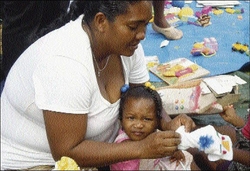
Maureen Campbell with her daughter, Kemmoresha. - Contributed photos
It's all fine and dandy that the University of the West Indies has a reputation for producing excellent doctors, nurses and so on, but how can people have any hope of coming close to entering tertiary institutions without sound early-childhood education and parenting? It's a known fact that a child's formative years are the most important in his or her development.
The Roving Caregiver Programme (RCP) was set up exactly for this. Though informal, it strives to help children, from birth to three years old, who have no opportunity to obtain any formal early-childhood education, and to train their parents in the basics of hygiene, safety, health, play and general parenting.
Sixteen years ago, the RCP was tried out with 10 caregivers. Three years later, in 1996, it was inaugurated officially, and 25 caregivers were brought in. They are still recruited from a pool of secondary-school graduates who wish to do community service before continuing on to further studies or careers. There are currently 35 in the programme and each of them deals with an average of 30 children.
The idea is for a caregiver to visit every home once per week, impressing on the parents the need to continue with the skills they acquire in these sessions. The caregivers are not paid to do this work, though they are given a small stipend to cover transport costs.
Strong family values
A few months ago I met with Utealia Burrell, executive director of the Rural Family Support Organisation (RuFamSo), a non-governmental organisation dedicated to bringing strong family values and a better life into rural communities. Burrell, along with her team of Yvonne Osbourne, Eda Golding and Hyacinth Pinnock, administers and runs the RCP.
Although I was able to get some idea of how beneficial this programme might be, it was imperative that I go and see it myself. Little did I realise that by visiting the RuFamSo centre, and the communities in which RCP assisted, it would take me back to where I grew up in Clarendon.
Close to the May Pen roundabout, we took a turn down a dusty track that seemed to lead to nowhere. This brought us into the community of Green Meadows. A session was already in full swing.
Although homes are visited individually, this early stimulation group was set up because it's a family consisting of the grandmother, her two daughters, a friend who lives next door and all their children. Caregivers, Shanique Murray and Stephanie Godfrey, dressed in smart purple uniforms, had given each of them hand puppets made out of socks. They were all singing with such happiness that tears came to my eyes.
Childhood
Basic socialisation and cognitive skills were then taught to the children, and the mothers were being encouraged to participate in all forms of play and conversation with their little ones, and to relish in the joy it was bringing them. It was as if they had previously perceived this way of spending time as being wasteful.
Spread out on a clean tarpaulin were building blocks, home-made tambourines made from plastic bowls and bottle tops, colourful cloth balls that had been hand sewn, and a toy box for each child, with her name on it. It brought back memories of my childhood when we played with what was available.
I asked one of the mums, Maureen Campbell, who had been in the programme for a year with her two daughters, ages one and three, what she thought of it. "It's a very good programme. It helps me to sing a lot, interact with strangers, and with my reading. It teaches my daughters about colours and shapes. I now have a happier relationship with my children."
When I asked her what advice she would give me as a parent in the making (then), she said, "Take them to the health centre and keep them safe from fires. Children need attention from day one. They need lots of attention."
>>> See Part 2 in The Gleaner next Monday.
Emmadaltonbrown@gmail.com
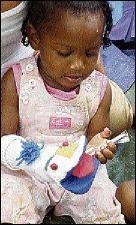
Kemmoresha with her homemade sock puppet.
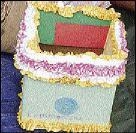
A toy box made by one of the children.