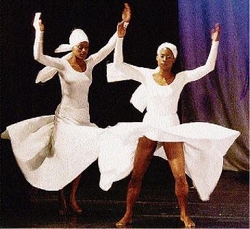
Left: This scene was picture-perfect at the Jamaica National Dance Theatre Company's 47th Season of Dance, held at the Little Theatre, Tom Redcam Avenue, on Friday.
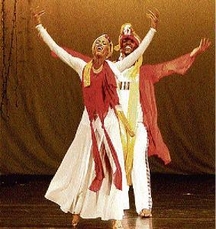
Right: There are some exciting pieces by this duo in the Jamaica National Dance Theatre Company's 47th Season of Dance. - photos by Winston Sill / Freelance Photographer
The youthfulness of the dancers onstage at the Little Theatre on Friday night belied the age of their troupe. In fact, the occasion marked the start of the National Dance Theatre Company's (NDTC) 47th season of dance.
Middle age though, has not turned out to be a time of slowing down or lowering of standards, but instead a "time of renewal and continuity". The quote is from NDTC artistic director and chief choreographer Rex Nettleford's message in the printed programme. "Renewal" refers to the many new works by younger choreographers, and "continuity" to the maintenance of "ancestral rootedness" and high standards.
An unusually small audience for an opening night (it was a benefit performance) saw a well-danced, beautifully costumed show, which was complemented by numerous delightful songs, mostly Jamaican, by the NDTC Singers. The quality of the evening's presentations augurs well for the rest of the approximately month-long season.
Dance aficionados will have to go more than once to see all the new pieces slated for the season. Four were premiered on Friday in this order: 'Caged' (choreographed by Kerry-Ann Henry), 'Movements of Peace' (Kevin Moore), 'Vignettes of Life' (Clive Thompson) and 'Apocalypse' (Nettleford).
Six other new dances are in the season's repertoire. Friday's revivals were Nettleford's 'Sly Mongoose' and 'Tintinabulum'.
Item one on the programme was the colourful, lighthearted 'Sly Mongoose'. This unusual work features the company of dancers as much as it does the NDTC Singers - the women dressed in pink and aqua and orange - and their drummers; the singers acting out their various songs, including I'm a Better Woman Than You, Moutamassi Liza, Shame Marjorie Murdoch. In De Buggy Bruk and the title song they do almost as much movement as the dancers.
Caged, a solo danced by its creator followed. "Sometimes we get so wrapped up in our emotions that we become consumed by them," is part of the explanation of the dance by Henry. She remains centre stage in a pool of light (symbolising the cage) throughout the dance, apparently trying, and failing, to get out through the bottom, the top or the sides. Her face, as well as her crawling, arching, twisting, writhing body, expresses intense emotion.
Moore's Moments of Peace begins with a solo by a distressed young woman (Keita-Marie Chamberlain) using a black shawl and a tree stump as props. However, her pretty costume hints that things are not all that desperate and she is soon comforted by two other similarly dressed girls (Henry and Stefanie Belnavis). The dancers move with great control and pose quite prettily.
The Singers
Next up were the Singers, six women and five men, who are not as a group as young as the dancers, though their voices give no less pleasure. Led by the talented composer-arranger and keyboard player Marjorie Whylie, the group performed (meaning sang and acted out) several Jamaican folk songs. They included Run Breda Rat, Free Town Gal and King Jah Jah.
Tintinabulum is a subtle dance drama with a strong storyline. It covers the lives of three males from babyhood to, not just death, but beyond death. In the various movements of the dance, showing the childhood, teen years and adulthood of the males, who take up very different occupations, the mothers are always around. They are proud and supportive most of the time, fearful sometimes, but always loving.
Nettleford's choreography and the dancers' interpretation of it are, throughout, completely convincing, so that the delineation of the characters, their stages of growth and their emotions are clear. The work's portrayal of three full lives, including the life hereafter, makes its impact powerful.
Vignettes of Life was the first dance staged after the intermission. Not surprisingly, in view of the title, the piece starts off with a series of brief solos. Different dancers, male and female, portray various characters and varied moods. Some we might see on the street - like the mad, crippled beggar. Gradually, showing his ability to structure his dance and get the climax to work, the choreographer brings the men and women together so that in the final scene, everyone is onstage.
Sinister female figure
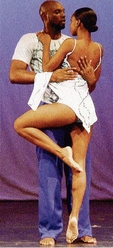
All clad in white, this pair performed elegantly at the season of dance, held at the Little Theatre, Tom Redcam Avenue, on Friday.
The mood and costumes, are at this stage quite cheerful, but suddenly, in the last 15 seconds, a sinister female figure in black and with lots of 'bling' sneaks in and tempts one man with an item of jewellery. An unexpected, intriguing twist in the tale.
Apocalypse, like so many of Nettleford's dances, tells a story. This one is about a man (Marlon Simms) who tries to lead a woman (Henry) into sinful ways - or what she, being naturally inclined toward a religious life, would consider sinful ways.
To the music of both Whylie and Chalice (Revival Style and Pocomania Day) performed by the NDTC Singers, the woman joins a revival group and challenges the 'sinner man'. He is in fact mauled by the entire community of women - this in an unusually prolonged scene of violence. On Friday, one began to feel sorry for the man as he is kicked and trampled.
To his rescue comes the brothers of the revival group. Interestingly, by dancing around him and with little or no actual touching, the brothers get the man to turn his life around. He joins and becomes a leader in the group, uniting, if not in a carnal way, certainly in a spiritual way, with the woman he had tempted.
Barry Moncrieffe's attractive costumes quickly and easily delineate the characters. The lively music makes us want to dance with them onstage.
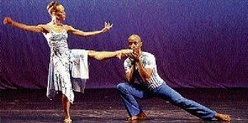
A scene from the Jamaica National Dance Theatre Company's 47th Season of Dance. - photos by Winston Sill/Freelance Photographer