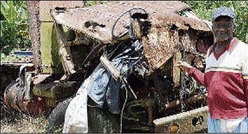
Oswald Thomas, 77, points to an old truck he onced used to transport his farm produce. He is the only living son of a World War I veteran who settled in Mexico, St Catherine. Norman Grindley/Chief Photographer
Somewhere in the hills of St Catherine lies a little community named Mexico, or 'Mestico', as the inhabitants tend to pronounce it.
However, they are nothing like the citizens of the Latin American country. They are just ordinary rural folk who spend most of their days toiling in the fields.
No one is sure how this little community got its name. But it may have been so named by World War I veterans who were placed here after the war ended in 1918.
"Dem did complain seh them get the worst land, because it did rocky," 64-year-old Emily Dawson-Mills told The Gleaner.
Emily and her husband, 72-year-old Uriah Mills, are among the handful of elderly folk still alive in the community; but they don't know much about how Mexico came to be Mexico.
World War I veteran
It seems the oral history of how the community got its name died with the second generation.
The only living member of that generation - 77-year-old Oswald Isaiah Thomas - shed a little more light. His father was one of the World War I veterans who settled here, but not even he could say for certain how the community got its name.
"I don't know how the name derives through ex-soldiers. Fi mi daddy used to tell me say him go places like Mexico and go over the world and all 'bout, you know. So it probably derive from there," he surmised.
He remembers each of the soldiers was given five acres of land. But, like Mills, he says none of them liked the area much because of its thick vegetation, rocky soil and remoteness.
Coal was once the community's major revenue earner. With its thick forest cover, it had a plethora of fine wood to choose from.
"It used to sell a Mullings' Grass Yard on Spanish Town Road. A dat everybody did have to live by, you know, and fi clear it out you haffi carry pon you head or donkey," Thomas said.
"Those days, it was special wood you used to burn - logwood, hardwood, wild orange," he listed.
However, the coal industry died because of resource depletion. It was, however, soon replaced by traditional farming. Yam became king and has retained its throne until today.
Mexico's yam is even better than Trelawny yam, residents claim, and the reason is simple.
"We nuh use too much fertiliser so we have the best yam," said Uriah Mills.
Most of their crops are grown organically, mainly because citizens don't have enough money to buy fertiliser. But organic farming has has its benefits, they have come to realise.
But apart from its produce, what makes Mexico so special is its solitude, the residents say, a fortunate consequence of its seclusion.
"We always say Mexico not on the map. But here so is a nice place. It (is) quiet and nice," says Dawson-Mills.
That, of course, has its advantages as well as disadvantages. Mexico's remoteness is probably responsible for its slow development. Up to six years ago, there was no electricity or paved roads and the residents would probably never have it if they did not mount a demonstration.
The smoothly paved roadway that the Gleaner news team drove on to reach Mexico was up to six years ago a mere trail which farmers trekked with heavily laden donkeys and which schoolchildren were forced to walk early mornings and late evenings.
Those are days Dawson-Mills doesn't want to return to.
"Me all memba when me used to light di pimento oil lamp and walk wid di pickney dem go school a Point Hill," she said.
A good portion of the road remains in a poor condition, however, which continues to make it hard for the farming community to get their produce to market, particularly those wanting to move their goods to Point Hill for sale.
grass and stone
"Me no have as much fi go Linstead, so a Point Hill me go and go get me one pound a dis and likkle a dat an' t'ing, but the road bad me a tell you," said farmer Harold Lewis.
What exists can barely be called a road really. It's all grass and stone.
But there is another problem: Mexico still has no potable water. Most of their water is bought from a community a few miles below them named Buxton Town. A drum of water costs $300 and that only lasts a family a few days.
"If you have all one, two drum, and you have one woman a yuh yard, that all last just one week," Lewis joked.
However, the lack of amenities has not dampened their spirits.
"We love it here, man, because it quiet. Dem never kill nobody roun' ya so yet. Everybody jus' live good," said Dawson-Mills.
It is true that the murder rate in Mexico is low, but this little community has been brushed by its share of tragedies. Ask Thomas about the year 1995 and you'll hear him sigh.
His youngest child, a 13-year-old daughter, was raped and murdered in the community. Ironically, the day we visited him marked exactly 14 years since the tragedy.
Her body was left in bushes on Thomas' 25-acre property.
"Them tek we nice 13-year-old child and murder her down that gully there," he said.
The recollection of the murder often makes him reminisce on what the community was like in its former days when the community was more closely knit than it is now.
Sick
"Anybody used to sick from here to Linstead, hammock go, hammock come," he recalled. "If you dead, hammock go, hammock come ... .
"Dem days, when a man die it's your responsibility. You gone dig one bag a yam and those days you must have nine-night (a Jamaican wake). Now anybody dead, restaurant open and it cost you," he said.
He now wants to sell most of his vast property.
gareth.manning@gleanerjm.com