File
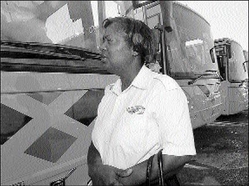
In this December 30, 2008, Gleaner photo, JUTC bus driver, Hainif Farquharson, inspects one of the new 'single-operator' buses while still on the wharf.
Mark Titus, Business Reporter
The Jamaica Urban Transit Company Limited (JUTC) has started the process of re-engineering the service it offers, but for now, the more genteel ride appears confined to the 50 yellow-painted units added to the fleet this year.
Part of the arrangement that the Government has with VDL Jonckeere, the Belgian supplier of the buses, is that its technicians must train drivers to operate the units, in keeping with the plan to use the JUTC as the standard-bearer for other public-transport operators.
Commuters in the Kingston Metropolitan Transport Region are used to seeing the white JUTC buses careening around the city, but in a fact-finding trip by Sunday Business from Portmore in St Catherine to downtown Kingston on one of the yellow units, the ride was different.
The steady beat of Bob Marley's Get up, Stand up was playing softly as passengers entered the bus.
The driver calmly pointed to a sign that read "No $500 or $1,000", firmly denying entry to a young man with one of the prohibited notes.
Fresh approach
The journey took some 25 minutes, with the driver main-taining an average speed of 70 kilometres per hour, while ignoring the grumbles and complaints of some passengers who wanted to travel at a more frenetic pace.
"This is simply the fresh approach that we promised the public," said Reginald Allen, spokesman for the JUTC and the Ministry of Transport.
"We cannot ask the sub-franchise holders to be at one standard while we operate at another level. We will have to set the example. The sector will be streamlined to develop standards of operations with uniformity, making it one public-transportation sector."
The ministry is trying to hone in on service quality, not only through human intervention, but also through the employment of new technology, a GPS tracking system to assist with route management and to ensure that buses are adhering to scheduled timetables.
What the transport ministry is shooting for is a system used in other more developed public-transport markets where buses operate on a timetable, and can be counted on to pull in at a particular bus stop at the time the schedule says it is supposed to arrive.
Zero tolerance of loud and lewd music
Already announced is zero tolerance of loud and lewd music. Drivers in the system will now be investigated and their music must be sanctioned as clean by the Jamaican Constabulary Force.
"All drivers are to be subject to a higher level of competency test," said Allen.
"There is a training regime being developed, which would include stress and anger management, customer service and dispute-resolution exercises."
The JUTC has already announced that it hopes to leverage 'courtesy' into revenue, giving passengers a better-quality transport experience.
Indeed, the State bus company, which competes for business with sub-franchise operator National Transport Cooperative Society (NTCS), as well as 'route' taxis, this year hopes to regain market share - moving from 49 million passengers transported in 2008-09 to 65 million in 2009-10.
The preliminary report on fare sales indicated a dip below the 2008 period, from $1.98 billion to $1.9 billion. At year end March 2009, the company made a loss of $2.4 billion, a portion of which was offset through a $1.15 billion government subsidy.
Government has since granted the agency a fare increase, in part accounting for its forecast that fare sales would hit $3.48 billion in this fiscal year.
Still, the bus company is projecting a loss of $1.37 billion, which Government will partially offset with a $776 million subsidy.
If the JUTC fails to revive earnings with this and other efforts, the debt-riddled JUTC - whose accumulated deficit is projected to hit $6.3 billion this year - is trying to reduce its record for accidents, and the attendant opportunity cost of fleet units being in repair instead of on the road, plus the capital needed to pay for the repairs.
Hefty repair bill
Preliminary figures show the company's maintenance and repair bill annually comes close to half a billion dollars, hitting $495 million last year, as reported in the most recent Public Sector Bodies report published by the Ministry of Finance.
Of the 600 units in the fleet, 400 are reported to be operational.
The Government has decided to end the sub-franchise agreement with the NTCS, which owes the State millions in unpaid licensing fees.
The JUTC is considering continuing a programme of individual licensing of private-bus owners, but Allen has said that they would be required to operate at the standards now being drafted by the State bus company.
mark.titus@gleanerjm.com