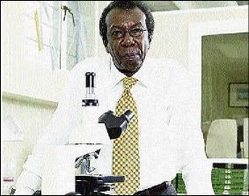
Hanchard
A retrovirus, HTLV-1, is a virus which has the ability to make copies of itself. It is found worldwide, but is more common in Jamaica and the wider Caribbean.
This virus is responsible for a number of diseases that affect several systems of the body. Some of these diseases include a unique leukaemia, a chronic paralysis of the lower limbs and a chronic eczema in children.
Much of the knowledge related to HTLV-1 in Jamaica was the result of a joint collaborative research project with doctors at the National Institutes of Health/National Cancer Institute (NIH/NCI), in Bethesda, Maryland, USA, and the Department of Pathology at the University of the West Indies (UWI), Mona campus.
As part of the research effort, the doctors tested everyone who applied for a food handler's certificate, pregnant patients at ante-natal clinics, blood donors and general clinic patients. The results showed that three to six per cent of the Jamaican population were carriers of the virus. Further tests confirmed that the virus was spread from one person to another through sexual intercourse, blood transfusion and from mother to child by breast milk.
Public education
These findings were shared with the Ministry of Health. The information was so vital to the health of the population that the ministry instituted the testing of blood for HTLV-1 in order to prevent spreading by transfusion. They also launched a public-education campaign to encourage safe sex practices and to give advice about breastfeeding.
The doctors then turned their attention to an examination of the diseases caused by this virus. In doing so, they not only found the leukaemia in Jamaican patients, which up to that time had not been recorded in the Jamaican population, but also discovered the association with the chronic paralysis of the lower limbs for which no cause had previously been identified. They also discovered a unique eczema, a completely new disease, in Jamaican children affected by the virus.
The recognition of these three diseases gained international acclaim for the Faculty of Medical Sciences. The HTLV project concluded in 2006 after 23 years of collaborative research with the NIH/NCI. Its immense contribution to world literature remains a landmark achievement in medical research in the Faculty of Medical Sciences.
Principal investigator of the project from 1986 until 2006 was Professor Barrie Hanchard. He succeeded the late Professor William Nigel Gibbs, former dean of the Faculty of Medical Sciences.
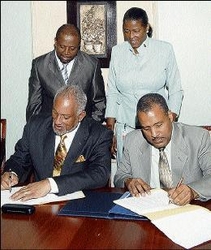
Photo by Aston Spaulding
The University of the West Indies (UWI), Mona, is planning to introduce an MSc degree in agricultural entrepreneurship in September 2009, as part of an initiative to create a new breed of farmer who will have both agricultural knowledge as well as the managerial talent and skill to create new products or to introduce new technologies in the agri-industry.
The programme will have a developmental focus, producing graduates who will be able to understand the role of agricultural research and apply recent agricultural knowledge, science and technology so as to achieve practical and long-lasting development. It will be geared towards graduates of the Department of Management Studies with an interest in agriculture, and students, in the Pure and Applied Sciences, primarily those with an agriculture background.
Enhancing agriculture
Speaking at a symposium held in March of this year titled, 'Caribbean Agriculture and Food in a Changing Global Context', Campus Principal, Professor Gordon Shirley, outlined the ways in which UWI is taking a leading position in enhancing agriculture in Jamaica through technology, creativity, research and training. He noted that over a five year period the UWI, Mona, has produced 369 agricultural papers, underscoring the fact that UWI has a number of linkages that can benefit the agricultural sector.
He highlighted that UWI is interested in reshaping agriculture as an aspect of entrepreneurship; therefore, risk management and analysis are essential tools to be learnt and will be incorporated into the upcoming programme. The new master's programme will encompass these aspects and a special group of graduates will be incorporated to test new technologies and to link them with policymakers.