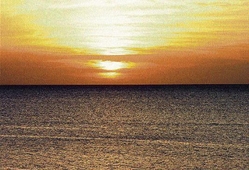
As seen from the Hip Strip, the sunset.
Today, we bring you part two of the Talk of the Town feature on Montego Bay.
Gloucester Avenue, more widely known as the Hip Strip, is full of alluring history. Complete with an ancient Jewish cemetery and the supposedly healing powers of Doctor's Cave Beach, the Hip Strip is also home to the historical Casa Blanca, the oldest resort on the popular stretch.
Liveliness exists on the Hip Strip day and night. For André Dixon, a Hip Strip pub owner, the variance between day and night on the popular road is distinctly apparent.
"In the daytime on the strip, it can generally have different types of energy depending on what day of the week it is. If a cruise ship is in port, then there's lots of walking traffic and buses moving visitors to and from all areas. So there's plenty of excitement," Dixon said.
"If there's no ship in port, then the strip can be a veritable ghost town, with the exception of Saturdays, Sundays and holidays when local patrons are out enjoying the beach."
Dixon said visitors are typically mingling on the Hip Strip during the early part of the evening and locals are present at night if there is scheduled entertainment.
Better served if ...
According to Dixon, the Hip Strip would be better served if vehicles weren't allowed on it at nights.
"If cars were not allowed during certain hours of the night, tourists and locals alike could walk freely on the strip to the location of their choice," Dixon said.
"There could be sidewalk entertainment and other events like festivals that would make the strip seem like an actual destination."
No matter the reason for one's visit, the Montego Bay Hip Strip remains a stirring street, visited by people from all over the world. The Hip Strip has been known to cater to and bring together different walks of life. Celebrities, locals, and foreigners can catch a football game at the 'old hospital' site amid the setting of an infamous beach, a colourful sunset, and a two-mile long strip of world-class restaurants, casinos, hotels, and bars.
- Stories and photos by Hope Evans
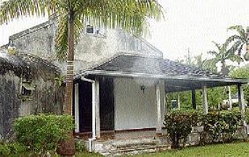
The eastern wing of the Johnny Cash Great House, complete with a hurricane shelter (left), faces the foothills of Mount Zion.
While many a great house occupy the St James passage, one has been forgotten, even though its elegant splendour and deep-rooted history have contributed to the making of a popular song performed by country great, the late Johnny Cash.
Cash, of Walk The Line stardom, occupied Cinnamon Hill Great House, also known unofficially as the Johnny Cash Great House, for 30 years. The home is situated near the infamous Rose Hall Great House.
It is said Cash was intrigued by the haunting legend surrounding the 'white witch' of Rose Hall so he decided to write a song about it, entitled, Ballad of Annie Palmer, which is still sung at the end of every Rose Hall Great House tour:
Where's your husband Annie where's number two, and three
Are they sleeping 'neath the palms beside the Caribbean Sea
At night I hear you ridin' and I hear your lovers call
And still can feel your presence round the great house at Rose Hall
Seated among ancient aqueducts, the great house was built by the famed Edward Barrett of Wimpole Street in the mid-18th century with an underground prison and hurricane shelter.
Spotted singing
Cash allegedly entertained several friends and guests with songs of old and could often be spotted singing on his guitar while children from neighbouring Mount Zion listened intently, or so an area caretaker known only as Moses, who has tended the Cinnamon Hill and Rose Hall great house landscapes for 29 years, would have us believe.
"They [Cash and his wife, June] used to love sitting at the outdoor gazebo," said Moses. "They enjoyed life and had their own way of giving back to the community with song."
The Cinnamon Hill Great House is not currently open to visitors; however, the area is available for private tours, dinners, and wedding receptions.
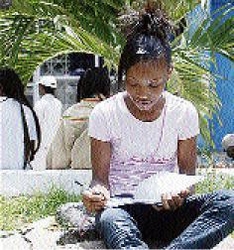
Melisa McLean finds a spot to write on the Sam Sharpe Square cobblestone.
Seventeen-year-old Melisa McLean has had what some may call a hard-knock life. Growing up in Clarendon, some difficult times made her doubt what her future would hold. Her situation had an interesting spinoff.
Whenever she worried or felt down, she would retreat to a secluded spot, wherever she was. Equipped with pen and paper, she'd write poetry nonstop and still continues to this day. She once wrote 135 poems in one day after what she called an 'emotional burst of energy.'
Previously a resident at Granville Society Girls' Home, Melisa has a new purpose. While she sees no opportunity for a writer in Montego Bay, she believes her skills will propel her to the place she desires to be in the future: writing for a major magazine or newspaper.
a lot to write about
"Writing comes easy to me," she said. "I have a lot to write about."
Unless she wanted to go into the tourism industry, Melisa said there were too few options in Montego Bay but she was determined to make a name for herself.
Her impromptu poetry writing sessions often leads to works about life, love, and survival. She enjoys letting her emotions guide her poetry, admitting she writes best when she is angry or saddened.
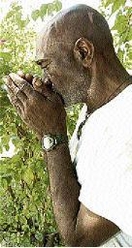
Wesley 'Radam' Daley explores nature with his senses near the St James Parish Church.
Self proclaimed amateur philosopher Wesley 'Radam' Daley considers himself a conscientious objector who is a victim of circumstance.
It is not often that someone will approach a person with the question, "what is the meaning of time?" Unless of course, that person is 'Radam', or 'Uncle', 'Big Man', 'Shine Head', 'Lion', 'The Mighty Greek', or 'Mr Tolbert', as he has been called, depending on the year you met him. But ask him any question, no matter what his name for the moment, and Radam will tell you the logical answer.
It is no coincidence, he says, that he spends much of his time behind the historic St James Parish Church in Montego Bay - he once had aspirations of becoming a preacher. Radam has led an interesting life that took him on a journey through Florida and, at one point, London. Now a deported nomad, he lives each day as if it is his last and hopes to one day return to travelling the world. He believes travelling has made him a more intelligent person.
Radam can often be caught spouting words of wisdom on various subjects. One of the more popular subjects he rants about is money. He views Montego Bay as a cesspool for people who "pree the dollar sign."
"If you focus on money alone, you will be a lost soul," Radam says.
Radam is a hopeful romantic, believing that one day he might be able to change Jamaica. He compares himself to National Hero Sam Sharpe, a preacher who helped free slaves and a man nobody thought could beat the odds.
"I live a life far alienated from the life I used to live," he said, admitting that he once attained money and power through illegal activities. "But I too intend to beat the odds."