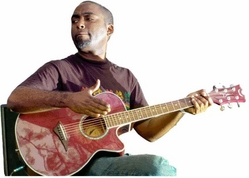
Seretse Small - Ricardo Makyn/Staff Photographer
Guitarist Seretse Small was also host, telling tales of songs and performers (Bijean telling the stories of his 86 Mark Lane and Suzie) on Saturday evening to bring a narrative cohesiveness to an excellent Jazz for Hope.
The interludes of talk between each song gave the audience, which filled the Hope United Church hall on Old Hope Road, St Andrew, time to soak in the song that had just gone and prepare for the one to come.
The breaks were necessary for full appreciation, as Small and the band of Alex Martin-Blanken and Ozou'ne (keyboards), Obel Davis (drums) and Paul Madden (bass) did not settle with playing songs. They extended and interpreted each (after Charmaine Limonius did Bridge Over Troubled Waters, Small complimented her on braving the band of improvisers), doing a lot of reconstruction around the basics of the original song in the process.
So close to the end of Jazz For Hope, guitarist Fitzroy Bennett ripped off a searing version of Amazing Grace in electric style, combining with former Two Guitars partner Small on acoustic guitar for the finale. Coming to the end of the first segment, the band turned Emmanuel Road into a somehow cohesive chaos worthy of being a soundtrack to Edgar Allen Poe's most macabre imaginations.
Jodi HoLung, Ruth Royes and Nikolai Sharpe, who also played keyboards at the start of Changing The Mirror, were the night's other singers, each coming onstage from the front left of the audience.
In the first segment of the programme, Royes was the voice on one of Small's favourites, Redemption Song, Small facing Davis and communicating physically as well as musically, which all the musicians did at some point during Jazz For Hope.
Small sat on the black stool that he seemed to occupy when racked by quiet passion for a redemption song of his own, Late Night Desire. He explained that it had been written when he was bed-ridden for eight months after an accident, on the first night he was away from the team of people that took care of him. He missed one person in particular and "the sense of loneliness I felt without that person is expressed in the very first line - the bassline".
Personal history
Bijean gave the personal history of 86 Mark Lane after delivering the dancehall-style song about his father neglecting his family while he went womanising ("When I was four/Sleeping on the floor/My only protection was the nail that cotch my door"), his voice reflecting the mood of each section.
Small explained that Emmanuel Road, known as a song for a popular ring game, came out of the immediate post-Emancipation experience when the women would break stones for road construction. The arrangement reflected both uses of Emmanuel Road, but more so the knuckle-breaking work where the music changed from a jolly clip to aching slowness, Small holding longer notes as he sang.
For Small, there was a hopeful note before the break, HoLung singing of inside-out emotions that he quipped he wished might be applied to him one day.
Uptempo music
There was more uptempo music in the second segment, from a Ruth Royes rendition of Summertime that had some snap and crackle to the closing Enough is Enough, where HoLung and Limonius shared vocals. Sharpe's Changing The Mirror was highly appreciated; she played the keyboard and sang the slower opening part to the chorus, then standing as Ozou'ne took her place to sing her joy in "no more need to be comparing me with everybody else".
Limonius' voice, which Small described as an instrument in its own right, did justice to Bridge Over Troubled Waters, which got reggae treatment in the band's extended extemporising.
The slow songs were beautiful (one heartbreakingly so), HoLung doing a melodious rendition of Over The Rainbow and Bijean explaining that Suzie, written by Bobby Treasure, was written about a little girl who was killed in Grants Pen in 2006.
Just before it was all over, Small thanked the audience, saying it's important that singers and musicians have an avenue that is open to music outside of "crass commercialism".