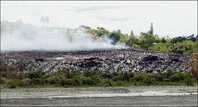
Fumes rise from the burning dump on the banks of the Johnson River in Springfield, St Thomas. Residents of Springfield who occupy land on the other side of the bank have been complaining bitterly about the smoke from the dump, the threat it has been posing to the river and the marine environment a few metres down stream. But close to 40 years since the dump was started, it continues to grow. - photo by Gareth Manning
There are problems in Springfield, St Thomas, but together the residents have been trying to solve them. The community hasn't been sitting down idly waiting on the Government.
Through their community club and other fund-raising initiatives such as walkathons, they have been raising funds to buy school items and to continue their community sports programmes, maintaining the community football field and buying gear for the football team. But the club has fallen on hard times, mostly because it does not get enough help or sponsorship from businesses in the parish to carry on its programmes.
The community has lobbied the Jamaican Foundation for Lifelong Learning (JFLL) to provide some educational support to residents, particularly for its youth who have fallen behind due to poor school attendance. JFLL will be seeking to work with the Social Development Commission (SDC) to facilitate the adult literacy centre in the community.
NWA made a commitment
The residents have also lobbied the National Works Agency (NWA) and the Ministry of Transport and Works to address the problem of flooding. The NWA made a commitment to provide the necessary funding to alleviate the problem and river-training work has been done, but no attention has been paid to the impact on the community.
The residents have submitted requests under the Access to Information Act in an effort to get information about a number of issues, including their legal status as a community and ways in which a community can become legal. They have also participated in a number of training events aimed at building their capacity to lead and address challenges. They have submitted a proposal to the National Council on Youth Development (NCYD), for which they received a government grant to carry out community development work.
Though the community has stood united, they seem to have had little impact on authority. They still face many challenges.
Despite their advocacy, the parish dump on the banks of the Johnson River has been growing daily, threatening the waters below that residents often use for bathing. When the dump is lit, it makes visibility and breathing difficult, especially for young children.
The community feels no one listens because most of them are believed to be squatters. "We hear them say the majority of the people them no buy them land. Them say a capture them capture it, but the people them paying tax, them paying tax," says community leader Devon Maxwell.
Council not recognised
"Them say the community no recognise through parish council," 39-year-old Patrick Gordon adds. Hence the community roads have not been fixed for years and other needed facilities have not been provided.
There is a community centre, but most of the premises is occupied by the SDC, which renovated the centre about a year ago. Residents see it as an important community resource for raising funds and hosting meetings, but since the renovation they say they have had difficulties accessing it. "We used to do penny concerts over SDC, but they fix up the building now, so they say we can't go over there now," Maxwell says.
Employment is marginal and has been so since the folding of the Goodyear tyre factory in 1997, and the banana estate. For most residents, the main form of employment is vending or 'hustling' which brings in money only seasonally.
With little money, they claim they can barely afford to send their children to school regularly. Most children attend school a mere three times per week.
Some residents have only recently received assistance from the Government through the PATH programme, but there are many others who are not on the programme, who are having it hard. "Most a we naa work. The community lack of job and so forth because Goodyear used to hold up the community," Gordon says.
The lack of work has been particularly burdensome on the community's only school - the Springfield Basic School. They have not had electricity at the single-room board structure for nearly three months now, because money has been a problem. "Their parents cannot afford itÉ so it definitely affects attendance," says schoolteacher Marcia Wright. The school hardly makes an income because school fees merely trickle in. In fact, the teachers often use their own income to help the children, including buying them lunch and school tools.
"The community need help. A nuff things we try fi done. A nuff letter we write and so forth. When something fi done, a that we hear at the appointed time [that we are squatters]," says Gordon.
Despite the challenges the community remains committed to continuing their efforts to improve their own lives.