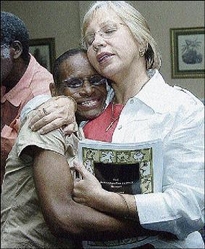
Dr Carolyn Gomes (right), executive director of human rights lobby, Jamaica For Justice (JFJ), gives a reassuring hug to Millicent Forbes during the launch of the JFJ's 2007-2008 report at the Knutsford Court Hotel in New Kingston last October. Forbes' teenage daughter, Janice Allen, was killed in a police shooting in 2000. - Peta-Gaye Clachar/Staff Photographer
TEN YEARS ago Susan Goffe had settled into her role of stay-at-home mother to her three children. After listening to a gripping radio interview about a controversial inner-city shooting, her life took on a different dynamic.
The interview involved Dr Carolyn Gomes of newly-formed human rights group Jamaicans For Justice (JFJ) and Jenny Cameron, mother of Michael Gayle, a mentally-challenged man who was killed by a Jamaica Defence Force soldier in Olympic Gardens in August 1999.
Goffe, a former teacher, said she was so struck by the intricacies of the case that she joined the organisation which was co-founded by Gomes, her children's paediatrician.
"Just listening to Miss Jenny ripped me open. It just touched me that a mother could have gone through such an experience," Goffe told The Gleaner.
Big court case
JFJ has made an impact on just about every big court case in Jamaica since.
The Gayle matter was its first major challenge. In August 2005, then Director of Public Prosecutions Kent Pantry ruled that no one was criminally responsible for Michael Gayle's death, but his family was awarded almost $3 million.
In addition to Michael Gayle, JFJ has been involved in the controversial Braeton and Kraal shootings, and the Janice Allen case which the group is still contesting after nearly 10 years.
Questionable police action was the base of the Braeton, Kraal and Allen cases, which resulted in the deaths of 12 persons. Goffe believes while attempts have been made to make law enforcement more proficient, the police have a long way to go before they gain the trust of most Jamaicans.
"In terms of police accountability and reform, a great deal of work needs to be done. We are still in a position where the police can commit murder with impunity," she said.
JFJ have challenged police action in several cases, something that has earned them the dubious tag of being anti-police. The Police Federation has accused them of irresponsibility and former senior superintendent Reneto Adams consistently described the group as a "criminal rights organisation".
Adams was leader of the Crime Management Unit which killed seven youths at a house in Braeton, St Catherine, in April 2001. The same team was involved in the deaths of four persons in Kraal, Clarendon, two years later.
On both occasions, the police were acquitted.
JFJ's relations with the legal community have not always been good either.
Pantry once called them misguided while they had numerous clashes with A. J. Nicholson, the former attorney general and justice minister.
Aggressive thrust
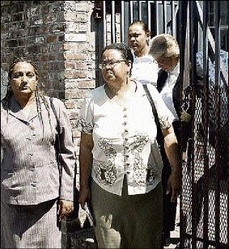
Monica Williams (left), mother of Jason Smith, a student of Eltham High School, who was allegedly shot and killed by three policemen on July 9, 2003, leaves the Spanish Town Court after the trial of the three policemen on Monday March 7, 2005. Also present are Susan Goffe (centre), and Dr Carolyn Gomes (right) members of Jamaicans for Justice, as well as Maria Mowat Smith (rear) , sister of Jason. - Rudolph Brown/Chief Photographer
Goffe has served as JFJ's chairperson and remains one of its spokespersons. She says the group's aggressive thrust has encouraged human-rights awareness and helped improved areas of Jamaica's justice system.
Yet, she says, there is still room for improvement.
"We still don't have a proper morgue and the backlog of cases in the courts has led to general lack of confidence in the justice system. But I think what we have shown with even our small victories, is a sign that things can change," she said.