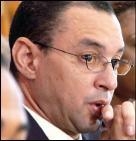
Senator Don Wehby, minister without portfilio in the Ministry of Finance. - File
On Tuesday, the Bruce Golding administration sent its clearest signals yet on the gravity of the economic situation facing the Jamaican economy.
Speaking at the Scotia DBG Investments inaugural Corporate Investment Seminar, held at the Hilton Kingston hotel, Senator Don Wehby, minister without portfolio in the ministry of Finance and the Public Service, provided the most comprehensive presentation of the underlying assumptions on which the current fiscal budget for FY 2009/2010 is predicated.
Going off-text, Wehby said the net international reserves (NIR) will likely be depleted to about US$800 million by March 2010, which would amount to a 52 per cent decline from current levels.
The reserves now stand at US$1.66 billion, sufficient for 12 weeks of cover for goods imports, and nine weeks of imports of goods and services. A year ago, the NIR had peaked at US$2.3 billion, but eroded steadily in the latter part of 2008 when the Bank of Jamaica began to tap into it as arsenal to defend the Jamaican currency.
Wehby said Tuesday that the expected decline was predicated on the challenges that faced the economy, such as external shocks related to the continued effects of the current global financial crisis or weather-related shocks.
Exploratory discussions
The Government of Jamaica is currently engaged in exploratory discussions with the International Monetary Fund and while the minister stressed that these discussions are only preliminary and non-binding, reading between the lines, it is clear that the Golding administration will likely be having further discussions with officials of the Fund in the very near future.
For 2008, gross domestic product (GDP) contracted by 0.6 per cent and in FY 2009/2010 the expectation is that the Jamaican economy will contract in the range of 2.5 per cent to 3.5 per cent.
In this regard, the Government expects "real sector activities to be affected by the declining demand for exports, lower capital flows, and a reduction in remittance flows," said the senator.
Inflation is expected to be in the range of 11 per cent to 14 per cent, "reflecting the recent depreciation on the exchange rate and some impact of the revenue measures," he told the forum.
The current account deficit is expected to narrow to 14.2 per cent of GDP, down from its current position of 19.2 per cent.
The reduction in the current account deficit is predicated on "weaker demand for imports and also commodity prices that are lower than those seen in 2008," Wehby said.
It should be pointed out that in relation to the historical performance of the balance of payments, the current account deficit for FY 2008/09 is the largest on record for the country.
Most of the deterioration in the current account in FY 2008/09 resulted primarily from the increase in the oil import bill.
In terms of the external impact on the projections for the current central government budget for FY 2009/10, the assumption is that the world economy is still in recession and the international capital markets will remain closed.
For programming purposes, the budget assumes that global economic growth is not expected to recover until mid-2010.
THE FISCAL BUDGET
Senator Wehby points out that the Government is "fully aware that a credible fiscal adjustment is a pre-requisite for restoring confidence and creating a virtuous cycle of stable exchange rates, lower inflation, lower interest rates and improved debt dynamics."
He also stressed the need for comprehensive tax reform as a critical component of Jamaica's national development strategy. In this regard, emphasis needs to be placed on a simplification of the Jamaican tax system which at present is burdensome and discourages taxable/formal invest-ment and business activities.
Wehby said that an Inter-American Development Bank report commissioned at the end of 2008 estimated that:
One per cent of Jamaican firms pay 71 per cent of all corporate income tax collected.
One per cent of registered entities account for 60 per cent of all PAYE collected.
One per cent of corporations pay 58 per cent of all GCT collected.
He also noted that of 178 economies covered in the last Doing Business survey, Jamaica was listed among the worst 10 countries where it is most difficult to pay taxes due to the number of different tax types, payment dates and tax rates.
renee.shirley@yahoo.com