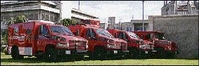
A fleet of Guardsman armoured trucks. The demand for security guards is trending down, and electronic systems now offer the best returns for security firms. - File
Faced with a sharp fall-off in demand for security guards, worsened by shuttered bauxite plants and contracting hotel operations, the sector of some 221 firms, save for marginal growth in the sale of electronics, including surveillance cameras, car trackers and panic buttons, is in a tailspin.
Fair demand remains for electronic systems, ranging in cost from about $17,800 per unit monthly for motor vehicle systems, to $390,000 one-time cost for business and residential security installations.
"There is no growth, just a constant juggle of clients between players. Those who cannot offer extended payment terms are losing their clients," said Commander George Overton, director of operations at Guardsman Group Limited.
Guardsman is the largest local private security company, which, along with its affiliates, has 14,000 guards on its payroll.
But while the sale of electronic security devices was said to be holding its own, Overton said: "We are not growing more than three to four per cent."
Donovan Callum, operations manager at Allied Security, which has 700 guards in its corps, said the crime situation is not sending more business the way of the private security providers.
"There is no growth despite the hike in criminal activity. We would have expected some growth but there is none."
The most current crime statistics reveal murders were substantially down from 687 in the period last year to 362 now.
But robberies and burglaries appear to be more problematic. In the month of March, break-ins rose by 83 per cent, and robberies jumped 40 per cent.
The hot security items now appear to be hi-tech electronics, mostly in demand by companies.
"The vehicle tracking product has been doing very well," according to Guardsman's Overton, who said operators in the distributive trade are the biggest users.
"The sector uses it for resource management and as a security tool to know where their trucks are, track them and reroute them. It gives them a whole lot of information more than any thing else.
Those involved will get an alarm when something goes wrong."
Geo-fencing
A new tool, known as 'geo-fencing' now appears to be the latest craze.
A feature of the motor vehicle tracker, geo-fencing is used to track deliveries en route, creating a virtual imaginary fence line around the area the trucks are expected to traverse.
If the driver deviates from the route, an alarm is triggered.
The cost of the system involves installation fees of between $17,800 and $22,500 per vehicle and monthly fee of between $200 and $2,000.
"We know where the vehicles are all the time. We have staff monitoring these devices," Overton said.
At King Alarm Services Limited, which provides electronics and armed response capabilities for its clients split evenly between residential and commercial, operations manager, Delano Virgo said business is on an even keel.
"Instead of two or three guards they (clients) are taking a panic alarm,' Virgo said.
The preference for electronic security over guards has also been beneficial to Technology Plus' bottom line.
"We are selling mostly automatic gates, burglar alarms for homes, cameras and panic buttons. We have been affected by the recession but it is marginal," said owner Joseph Francis.
"On the domestic side we are not getting as many calls as we used to, but on the commercial side there is marginal increase."
Commercial security customers are believed to be moving away from guard service because of cost and reliability considerations.
The cumulative effect of wages and other payments, including insurance, uniforms and laundry, is to make security personnel more costly than automated options.
Additionally, electronic security systems are accepted to be more reliable than humans.
"Guards go to bathrooms and do other errands. The electronic security system never rests," Francis explained.
Rationalising
The average guard service costs $600,000 each year, per guard, while electronic systems involve a one-time capital expenditure of $390,000 for door access, panic alarm and a camera system, according to Francis.
He adds that electronic systems are up to 70 per cent cheaper than guards.
For Guardsman's Overton, "What we are actually seeing now is further rationalising in the number of guards being deployed and complementing that with electronics," he tells the Financial Gleaner.
However, he cautions that: "You cannot go all electronic; you need a complementing mix."
avia.ustanny@gleanerjm.com