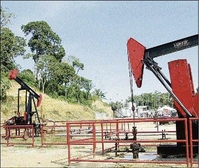
Oil equipment at the Petrotrin refinery in Trinidad. - File
Over half dozen African energy ministers and senior officials were in Trinidad and Tobago this week to get guidance
The two-day high-level meeting with Prime Minister Patrick Manning and his energy experts included Cote D'Ivoire, Gabon, Ghana, Nigeria, Tanzania and Uganda.
Ghana's Energy Minister Dr Joe Oteng-Adjei said he was attending the meeting to learn how Trinidad developed its gas sector.
"I'm here to understand the policy aspect of it, the master plan, look at how we can maximise the use of it, what options are available to us - whether to use it for electricity, for transport, for the petrochemical industry, what is the optimum mix?" said Oteng-Adjei who led a five-member delegation to the discussions.
"The prime minister said they have committed themselves to support Africa at no cost. We want to work and make sure that this south-south cooperation concept is realised."
Preliminary discussions
In January 2007, at an African Union Conference of Heads of State and Government in Addis Ababa, Manning made an offer of assistance to members of the African Union for the development of their petroleum industry at no cost to them.
Since then, Trinidad's energy experts - both policymakers and professionals - visited Chad, Gabon, Nigeria and Benin in 2007 to have preliminary discussions with members in the energy sector.
Following this mission, a Nigerian delegation came to Trinidad that same year to meet with state and private energy stakeholders, and see first hand the operation of the oil refinery, industrial estates and plants.
Missions from Uganda, Cameroon, Angola, Gabon, Ghana, South Africa, and most recently from Tanzania also visited Trinidad.
At the opening of the African energy ministers meeting this week, Manning highlighted the shared history.
"This is one concrete way of strengthening the historical ties between Trinidad and Tobago and the continent of Africa," said the Trinidadian PM.
"It is also an example of the South-South cooperation to which we have always aspired. Most importantly, it is an opportunity to join efforts to make ourselves stronger in a world that it is full of challenges for all nations, but particularly those that are characterised as developing."
Trinidad and Tobago's Energy Minister Conrad Enill said global forecasts for energy consumption point to carbon-based fuels continuing to play a dominant role in the energy mix for several decades to come.
" As such, astute management of these resources and maximisation of the developmental opportunities that arise from a country being in possession of oil and gas is absolutely critical to realising your individual government's development agendas," he told the delegates.
During the two-day meeting, the African delegations heard presentations from officials from state companies on some of the strategies and policies that were applied to help Trinidad and Tobago develop its energy industry.
Various issues
Senior state counsel at the Ministry of Energy, Indira Ramkissoon said the meeting was aimed at reviewing the various issues experienced by individual countries, business opportunities, the policy, legal and regulatory agenda, existing proposed development thrust in natural gas, upstream and refining areas and examining the challenge of sustainable energy.
"What we will do over the next two days is foster an ongoing dialogue about energy that will continue long past today and ultimately lead to a blueprint for how we transition to the next stage of development, how we organise the competing interests and concerns about energy in a way that protects our economies," said Ramkissoon.
business@gleanerjm.com