Wilberne Persaud, Financial Gleaner Columnist
Is Jamaican effort at fashioning strategic economic policy defunct?
Think of the Pioneer Industries Act 1949 implemented based on the Eric Williams-commissioned, Lightbourne piloted Arthur Lewis industrialisation model.
Denatured before execution, this policy implementation's predictable failure earned the disapproving title 'Industrialisation by Invitation'.
Regional economic integration in its various forms emerged to the current CARICOM Single Market and Economy .
Intermittently, we attempted self reliance, in a highly ideologically-charged political atmosphere superseded by enforced buy-in to International Monetary Fund/World Bank structural adjustment models, export oriented hi-tech farming a la Spring Plains, and First-World status in 20 years. Now we really can't say.
Our apparent choice is ad hoc antidepressants. Should we tinker with government consumption tax, tweak it a bit, insufficiently, regarding whether subsidy truly benefits those it is designed to help?
Effortless confusion
Adjust interest rates on student loans, sell the Jamaica Pegasus, Trelawny Cricket Stadium and Long Pond sugar estate? For a populace contemplating these moves as 'hardships there shall be', black green and gold must now create effortless confusion.
Admittedly, it's difficult to set goals for two and a half million extraordinarily self-assured, independent-spirited Jamaicans not about to roll over and play dead in the struggle for success.
Seemingly, we react to events.
Can't see beyond the five-year term? Can't transform political mandates into long-run effort involving sacrifice?
Can't craft policy except that advancing agendas of special interests from which political parties garner campaign funding - turf builders, political contributors and garrison domains?
What retards efforts to pick a seemingly distant star, approaching it even if by hesitant, incremental but hopefully successively successful steps?
Consecutive governments failed to harness that extraordinary Jamaican self-assurance to commit to personal effort for greater good in the long term.
I recall what must be described as anecdotal, but perhaps faithful truth: Edward Seaga, confronted by political contributors objecting to a 'people-oriented' policy measure of his government responded by asking a question, a debate-shattering question - "who did the people vote for"?
Two things lead me to raise these awkward questions. First: recent news reports about the Trelawny Cricket Stadium, and sale of The Jamaica Pegasus. All ad-hoc measures designed, or rather, stumbled upon to fill budgetary holes guided by no strategic objective.
Bobby Fischer and Boris Spassky knew better in their chess games, highly complex if not entirely faithful mirror to the game of life. Second is comparison between past Jamaican and Barbadian responses to IMF prescriptions in periods of economic stress.
What can we say about ad hoc initiatives bringing a few dollars to government coffers? Trelawny Stadium's promise shouldn't be squandered merely for rental income.
Its future should be conceived strategically to enhance human deve-lopment with income generation.
This agreed, its twinning with any institution of higher learning in the country should be The University of the West Indies (UWI).
Beyond dispute the region's leading academic institution, UWI embodies the foremost set of diverse accumulated resources that would both add to, and maximise value of an enterprise building on United States' university models encompassing sports - reinvention of the wheel unnecessary.
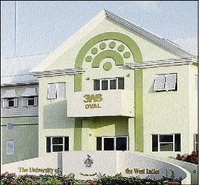
Approaching UWI Mona's sister campus, Cave Hill, Three Ws Oval is the undisputed attention-grabbing presence.
This facility makes Mona Bowl and Sir Frank Worrell pavilion appear for what it is - travesty to such a memory.
Sir Frank fashioned a West Indies cricket team that became world leaders for two decades and was one of UWI's earliest and outstanding hall wardens.
Three Ws Oval, a strategic vision assisted by West Indies hosting Cricket World Cup is likely to pay huge dividends: it nurtures youth, Combined Campuses and Colleges team with a character building programme and among other things, an imposing home ground.
Decision-making protocols
The unitary university with specialised faculties reaching critical mass quickly and with students intermingling from all across the region was a fantastic tool creating a well-informed, sophisticated, truly Caribbean citizen.
Events have overtaken this. Campus-based decision-making protocols cannot be infused with the kind of give and take that 14 governments' diverse objectives inevitably rendered beneficial to the West Indian population as a whole.
Consider the West Indies cricket team - despite current under-performance - as opposed to 14 separate teams in the cricket world. Consider the Eastern Caribbean central bank's ability to hold the value of the EC dollar for decades.
These outcomes are not independent of the inability of each separate political domain to fashion policy to the tempo of the five-year term.
Trelawny stadium should be, just as Mona lands were, a gift to the regional UWI - the centre - with express objective to provide a regional facility on the model US universities employ.
A strategic move, it will enhance our younger generation's prospects, culturally, academically, physically and yes, spiritually while simultaneously generating income.
Selling Pegasus brings cash, but at what value, what ultimate cost?
Emergency general meeting denies minority shareholders' ability to name two board members. The hotel is sold, most likely undervalued, private interests make a killing and government funds short-term requirements - for two years? Family silver sale?
Current crisis
My last column ended by asking whether the current crisis was "sufficiently tough to make us understand that we are really all in it together and that the massive differentials in what stakeholders take away from the table cannot be a good thing?"
I suggested this was possibly a "non starter and wishful thinking yet, if we could tackle it successfully, what a greater place this would be."
This is the point of different responses Jamaica and Barbados made to economic ill health under threat of IMF structural adjustment.
Barbados' response was this: government, owners of capital, private sector and labour, the stakeholders, all viewed themselves as Barbadian nationalists, buying into anti devaluation, sacrifice and need to provide all resources required to avoid the deluge.
Jamaica, possessing by any measure, a tremendous advantage in physical wealth, didn't choose this response.
Barbadian political analysts attribute this to centuries old differences. Absenteeism among the Jamaican planter class - the colony of exploitation mode - permeates modern attitudes of capital not seeing survival as requiring an inclusive nationalist perspective.
Privileged Barbadians, historically white as a matter of policy, fighting against Crown Colony government, accumulating capital over the years, still view themselves as Barbadians, long seeing their salvation at home.
Modernisation changes this, yet could this attitudinal difference explain the basic cause of our inability to approach 'first-world status' for all?
Many in Jamaica live beyond first-world status! This is conjecture, but if true our economic problems are anything but purely economic. No combination of asset sell-off and realistic econometric modelling will take us truly forward.
wilbe65@yahoo.com