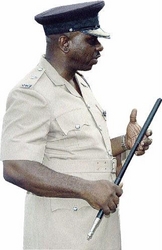
The alleged video and audio recordings of Superintendent Harry 'Bungles' Daley accepting protection money from a businessman have sparked many verbal clashes in court between lawyers for the defence and the Crown.
Senior Resident Magistrate Judith Pusey is to rule on Wednesday whether she will admit the recordings into evidence.
Daley is the first senior police officer to be charged with extortion and breaches of the Corruption Prevention Act. The trial began on April 21. After a two-week hearing in the Corporate Area Resident Magistrate's Court, the case was put off to July 13.
The trial had to be adjourned because the defence lawyers said they had other cases which were previously set for trial in the Home Circuit Court and cases for trial in that court take precedence over cases in the RM court. The RM also has other cases listed for trial.
Daley was held during a sting operation on Arnold Road, Kingston, on July 31 last year allegedly collecting $15,000 in marked $1,000 notes from businessman Tafari Clarke. Daley is facing six counts of extortion and six counts of breaches of the Corruption Prevention Act.
Bungles is now being tried for one count of breaching the Corruption Prevention Act arising from the July 31 operation.
The other acts of corruption allegedly took place in St Catherine and trial in relation to those charges is expected to take place in the Spanish Town Resident Magistrate's Court.
During the trial, Assistant Commissioner of Police Justin Felice, who was the first witness called by the prosecution, said in February 2008 Deputy Commissioner of Police Mark Shields introduced the complainant to him. He said he conducted background checks on the complainant. Felice said he ordered the setting up of the recording device.
Tafari Clarke, the 25-year-old complainant, was responsible for collecting rent at Bongo Plaza in Ewarton, St Catherine. He said his uncle built the plaza.
He testified that a man called Terry was harassing the tenants at the plaza because he wanted to collect rent from them. He said in 2007, he and his father, Linton Clarke, went to Daley about the problem and Daley sent them to Inspector Norman McDonnell at the Linstead Police Station and McDonnell resolved the matter.
Clarke said he and his father went back to Daley's office where he gave Daley $20,000. Clarke testified that he and Daley discussed how much money was coming in from the plaza and Daley told him he should pay $20,000 monthly. Daley told him after he gave him the money that if anyone troubled him, he must be the first to know. He said from July 2007 to July 2008, he met with Daley monthly and paid over the protection money.
Collecting money
Clarke Jr said sometimes Daley received $10,000, $15,000 or $20,000 depending on how much he collected for the rent. He said he went to Daley for assistance because he was not getting any help from the police and Daley was his father's friend.
In February 2008, Tafari Clarke said he reported the matter to the Anti-Corruption Branch. Clarke said the police wired him for six months with a mini camera to record the meeting and handover of protection money to Daley.
He said he met with Daley on St Johns Road in Spanish Town, St Catherine, where he paid the money. He said money was paid in Kingston once - on July 31 last year.
Linton Clarke testified that sometime in 2007, he witnessed his son paying money to Daley. He said he and Daley had been friends for 36 years.
He said he and his son went to Daley because his son was having problems collecting rent from tenants in a plaza in St Catherine and Daley sent them to the Linstead Police Station.
The police there were helpful in getting a tenant to pay the rent. They returned to the Spanish Town Police Station to tell Daley thanks and on that occasion he saw his son give Daley some money but he did not know how much it was. Clarke Sr said he and Daley had lived in the same community and he had sometimes cooked for Daley. He said he used to roll ganja spliffs for Daley and they smoked together.
The defence lawyers challenged the testimony of the witness and suggested that the reason he was telling lies on Daley was because he had an axe to grind. The witness disagreed.
Corporal Nigel Pencil, assigned to the Anti-Corruption Branch, said he fitted Clarke on several occasions in 2008 with equipment to capture the alleged handover of protection money.
POSSIBLE EVIDENCE
He said after the images were captured, he processed them on his computer and prepared tapes, sealed them and handed them to Felice. He said the only other sealed copies were prepared for the courts.
Pencil said the seals for the copies of the videotapes he prepared for the court were broken in the presence of a prosecutor, the defence lawyer and Felice and then resealed.
Defence lawyers Valerie Neita Robertson, Caroline Reid-Cameron and Chuckweana Cameron objected to the videotapes being tendered into evidence. The defence is contending that the recordings may have been tampered with by the police to paint Daley in a bad light and should not be admitted in evidence.
Dirk Harrison, deputy director of public prosecutions (DPP), and prosecutors Kamar Henry and Loxly Ricketts are contending that the recordings were not tampered with and should be shown in court. The prosecutors said there was legal authority for the recordings to be admitted into evidence, referring RM Pusey to the decision of the Court of Appeal in the rape case of Lynden Levy and others in which a videotape was admitted in evidence at the trial and Supreme Court Judge Donald McIntosh's decision to admit the videotape into evidence was upheld.
The Crown is alleging that Daley collected a total of $65,000 from Clarke between May 2007 and July 2008.
The deputy DPP also disclosed at the trial that Daley's assets were being scrutinised by detectives from the Financial Investigations Division.
barbara.gayle@gleanerjm.com Jonique.gaynor@gleanerjm.com
CLARIFICATION
In a Gleaner Editorial dated Sunday May 10, it was incorrectly stated that Assistant Director of Public Prosecutions Dirk Harrison had a full diary as part of the reason for delaying the case of Superintendent Harry Daley. Harrison was ready for a continuance. We apologise for any convenience.