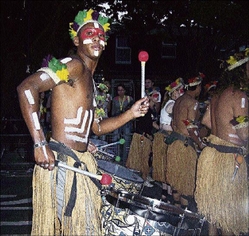
Masquerade: playing the drums.
It's the one place and one time of year that offer the best of many worlds. A sidewalk bar or café within metres of swirling waves conjures up images of Venice, Italy.
Vignettes of the people's African roots are highlighted in the numerous displays of culture in music and dance. The traveller easily recalls the energy and dynamism of Louisiana's Mardi Gras, and the masquerade shares the colour and splendour of carnival in neighbouring Trinidad and Tobago.
Grenada's carnival or - to use the more appropriate official title 'Spice Mas' - is definitely world class. But it's also uniquely local and distinctly Caribbean. In fact, it's genuinely summer's last Caribbean jump up; the 'last lap'' of carnivals in the region.
Modern Grenada carnival started its indigenisation after Africans were freed from the bondage of plantation slavery in 1834. Their carnival, unlike the 18th century pageantry of upper class French settlers, was a commemoration of emancipation, which was first dominated by stick fighting and Canboulay, a processional cane harvest celebration held on the night of August 1.
Many, including Guyana-born Kimani S.K. Nehusi of the University of East London's Afrika Studies Centre, trace the origin of carnival to harvest festivals in Ancient Egypt. The African nexus of carnival is supported by Olaogun Adeyinka, a Trinidadian with family ties in Grenada. He was a contributing writer for 'Ah Come Back Home', a book on carnival that was published about ten years ago.
"I would never deny that other people have contributed to this festival, but we must not allow its African origins to be submerged,'' demands Adeyinka. "The myth of carnival, having come from the French settlers, is widely spread today. We must protect its Africanness, stand fast, and draw the line in the sand.''
In the one hundred and seventy-five years since the enslaved Africans were emancipated, carnival has evolved and it's continuing to do so. What has not changed, though, are the African elements of drumming, masking, high-spirited merriment, and parodying in song and dance.
The Africans creolised the French word for the evil Satan, diable, and created a devil masquerade that is now popularly known as 'Jab Jab'. While other carnivals, such as in Trinidad and at Labour Day in Brooklyn have their Jab Jabs, nothing compares to the jovial, villainous Jab Jab masqueraders who playfully haunt the streets of Grenada at J'Ouvert.
Jab Jab, J'Ouvert and Monday Nite Mas
Traditionally, Jab Jabs would use any available substance, including stale molasses, tar, grease or mud, to darken their skins to an extreme blackness. Sparsely dressed and accessorised with items such as broken pots and pans, cattle horns and cow chains, the intent of the Jab Jab was - and still is - to horrify and gross out onlookers. Jab Jabs now appear in various colours, including yellow and blue.
Jab Jab has also spawned its own calypso spin-off, 'Jab Jab Music', which is the most glaring indigenous, locally-made artefact of Grenada's carnival. Jab Jab Music is characterised by a deep rhythmic bass accompanying conch or flute blowing, and a repeated chant as part of the chorus. For example, Grenadian Tallpree scored a mega regional hit with his Ole Woman calypso. Audiences everywhere were singing the refrain:
Ole woman we taking home
Ole woman alone
Ole woman alone we taking home
Ole woman alone
Ole woman we taking home
In actuality, Grenada's Spice Mas is essentially about six weeks of festivities, spanning all of July to mid-August. It's an interval of frenzied, non-stop partying and cultural shows and competitions. It was not always held in that period. Historically, carnival preceded Lent as it does in places such as Trinidad and Tobago, Dominica and Brazil.
In 1981, Grenada shifted its carnival time and transformed it into a summer event, leading almost instantly to a surge in mid-year visitors and a blossoming in artistic presentation and creativity, particularly in calypso composition and competition.
Carnival Monday
Many tourists choose the final weekend as their arrival time, not daring to miss the culmination of the festival with its street masquerade on Carnival Monday and Tuesday, which are August 10 and 11 this year. Masquerading on Monday opens with J'Ouvert. The day ends with a spectacle called Monday Nite Mas.
The word J'Ouvert itself is Grenadian and Caribbean neologism. It's from the French words jour, which means day, and ouvert, which stands for open. In its practical modern application, J'Ouvert - which begins at daybreak - marks the opening session of the final two days of carnival.
It's only a recent phenomenon but Monday Nite Mas is a highly anticipated event. A T-shirt party and theatrical show, it is set against the backdrop of the cooling evening temperature with steady winds blowing across the picturesque Carenage harbour and waterfront. It's the Carenage - or 'The Wharf'' as many Grenadians are wont to call the place - that's the main thoroughfare for Monday Nite Mas.
Preceding J'Ouvert and Monday Nite Mas are keen competitions for bragging rights and cash prizes in soca, calypso, beauty pageantry and steelpan. Calypso and soca have had a few multiple-time winners; virtuosos like King Ajamu, Scholar, Flying Turkey and Smokey.
Angel Harps and New Dimensions have more combined pan championship titles than there are fingers and toes on a regular man or woman. Harps, the national panorama winners of 2008, is Grenada's oldest steel band, having been founded in 1965. The band, whose musical arrangers have included a Catholic priest and a commissioner of police, was the first Grenada steel orchestra to record an album of pan music. The album, Brighter Out of Darkness, was released in 1973.
Grenada has two of its best cultural enthusiasts spearheading the planning of Spice Mas 2009. Arley Gill, a lawyer, is the minister of state in the Ministry of Culture, and the government's point man in this year's carnival preparations. University administrator Colin E. Dowe, a cultural commentator and calypso judge, is head of the Spice Mas organising committee.
There are novel events for 2009. Senator Gill and Dowe are coy about the precise details, only dropping broad hints that "something is being planned for Morne Rouge in the south of the island.'' They also disclose that they are "well advanced in exploring the possibility of doing something special in the parishes outside of St. George.''
When the final schedule of events for Spice Mas 2009 is released, Senator Gill promises that it will be a wonderful programme.
"We guarantee to every Grenadian and every visitor to Spice Mas 2009,'' said Mr. Gill, "that it will be an exhilarating and exciting showcase they are not likely to forget.''
Dowe, for his part, says the final programme will ensure that "from north to south, east to west, in all corners, in every parish, the carnival spirit is experienced and enjoyed.''
Carriacou and La Baye
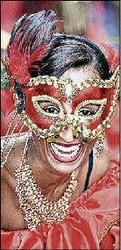
Masked Lady: dancer in vibrant costume.
The momentum to Spice Mas is enhanced by Rainbow City Festival and Carriacou's Regatta, two other pieces of the local cultural mosaic.
Rainbow City Festival is held in St. Andrew, Grenada's largest parish. But don't get befuddled if someone invites you to Rainbow City Festival in La Baye. It's a French name still widely used to refer to St. Andrew, which is also called the 'Big Parish'.'
One would be hard pressed to have a discussion in St. Andrew without mention being made of Black Wizard. Born Elwin McQuilkin, Black Wizard is a favourite La Baye son, a former Calypso Monarch, and a superb songwriter - arguably second only to Trinidad's Winsford 'Joker' Devine. At age 66, Devine has written more than 400 calypso and soca songs for performers like Grenada-born Mighty Sparrow, the undisputed Calypso King of the World. He has also composed for Machel Montano, Singing Francine, Scrunter, Trini, Blakie, Crazy, Baron, Explainer and King Austin.
As well, Devine penned the Grenada Road March song, Madness, which was sung by the musical 'Hit Man' Elimus Gilbert. Elimus, whose calypso sobriquet is Inspector, hails from Grenada's northern-most parish, St. Patrick.
Rainbow City Festival, a potpourri that blends items such as carnival show, gospel concert and arts and craft exhibition, will be held from July 31 to August 3.
Aquatics and bacchanal
However, no visit to our shores will be consummated unless a stop is made in Carriacou and Petite Martinique, which are part of the nation-state of Grenada. A short plane ride or travel by boat will first land you on Carriacou, which has kept its carnival as a pre-Lenten celebration. What Carriacou does have in the summer is a Regatta, which is an eclectic of aquatics and bacchanal.
There are the inevitable boat races during the nine-day Regatta, scheduled this year from July 26 to August 3. The conviviality of the Carriacou Regatta also includes fetes, boat cruises and concerts that bring together the créme de la créme of local and foreign artistes.
Splendidly beautiful Carriacou, normally relatively quiet, is steeped in African cultural traditions. An intrinsic part of daily life in Carriacou is the island's inveterate bond with Africa, vividly portrayed in drumming and dancing. Dance - with the Big Drum taking priority - is pivotal to all communal activities, including boat launching ceremonies. The people of Carriacou are also distinctive for musical commentaries that are sung in French Creole, or English interspersed with African phrases.
With the sampling of Spice Mas, Rainbow City Festival and the Carriacou Regatta, there is an abundance of pleasurable activities to tempt the epicurean to over-indulge.
- Lincoln Depradine