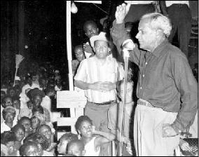
National Hero Norman Manley addresses a crowd in this 1967 Gleaner photograph. Manley passion for rights for banana workers was instrumental to the formation of the Jamaica Welfare Limited in 1937.
Older Jamaicans will remember the United Fruit Company (UFC), which ruled the roost in the heydays of the banana industry here. The UFC was a major multinational player in Latin America and the Caribbean, bigger than most national governments in the region.
Private enterprise, both in development and commerciali-sation, drove the technologies which transformed communication and trade in the 19th century, creating a truly global economy. These technologies were the railway, the steamship, the telegraph and, later, the telephone. The UFC was a leading example of private enterprise which integrated and extended these technologies for business.
In 1870, Captain Lorenzo Dow Baker, on a shipping trip to Port Antonio, bought 160 bunches of bananas for a shilling per bunch (about US 10 cents). Baker raced his cargo to Jersey City in 11 days of sailing where he sold the bananas for US$2 for each bunch. Baker later joined with Bostonian entrepreneur Andrew Preston and others in 1885 to form the Boston Fruit Company to develop a banana trade between Jamaica and Boston.
In 1899, the Boston Fruit Company merged with other companies founded by Minor C. Keith to become the United Fruit Company. Keith had built railroads in Costa Rica and then went into the fruit business. United Fruit established a monopoly on the production and distribution of bananas in Latin America in the early 20th century, a monopoly which lasted into the 1970s in places. From its banana trade, railway and telecommunications base, the company became a major economic and political force in the region, influencing the rise and fall of governments in the 'banana republics'.
In June 1970, United Fruit merged with AMK Corporation, which owned the John Morrell meat company and was controlled by Eli H. Black, to become the United Brands Company. After Black committed suicide on February 3, 1975, by jumping out of the window of his New York City office on the 44th floor of the Pan Am Building, Cincinnati-based American Financial, one of millionaire Carl H. Lindner Jr's companies, bought into United Fruit.
Advertising campaign
In August 1984, Lindner took control of the company which, in 1990, was renamed Chiquita Brands International after the famous Miss Chiquita character first introduced in an advertising campaign in 1944 and which had become the main element of brand recognition internationally.
The United Fruit Company in Jamaica was the principal financier of Jamaica Welfare Limited, founded in 1937. The company agreed to put up one US cent per stem of banana exported from Jamaica to finance the organisation to be established and administered by Norman Manley for "the good and welfare of the people of Jamaica, with emphasis on the rural people". At the time, one cent from each bunch of banana provided 25 million cents annually or US$250,000.
United Fruit in 1904 completed an unbroken string of wireless communication from the United States to South America. It was the first to bring this new technology to the tropics so that the ships at sea could communicate vital information with company locations in Latin America.
In 1913, the Tropical Radio Telegraph Company was established as a wholly owned subsidiary of United Fruit to take over and operate the parent company's radio network. In order to administer its far-flung operations, the company became a major developer of radio technology, which it later pooled with other companies to form the famous Radio Corporation of America (RCA).
The UFC's Great White Fleet, at the peak of its power, had as many as 95 vessels. The company owned an extensive rail network in Latin America and an extensive telegraph system for speedy communicating over its vast transnational business empire.
When J. Hedley filed his report to Governor Sir Edward Denham on creating an all-island telephone system in 1937, he included a tart memorandum from an agent of the United Fruit Company in Montego Bay to the manager of the Hotel Casa Blanca, demonstrating the independent telecommunications power of the transnational company:
Jamaica Division.
Dec 16th, 1936
United Fruit Company,
Montego Bay.
To: Manager, Hotel Casa Blanca.
Sir:
During the past tourist season, it has been a regular habit of hotels to transact business with our office, before and after office hours, i.e., before 8 a.m. and after 4 p.m., for the purpose of arranging accommodation for visitors on our ships, etc., etc. - also for visitors themselves at their own instigation, or advice of the hotel management to transact the same sort outside office hours.
This is to advise that this season our office hours for business is 8 to 4 on weekdays and 8 to noon on Saturdays, and on no account whatever will any business be done before or after these hours. No business whatever on Sundays.
Kindly note and make a point of advising visitors to this effect.
I also desire to once again point out that visitors will not be allowed on our wharf premises for the purpose of seeing the way bananas are handled except during the hours of 8 a.m. to 5 p.m.
Kindly see that all visitors who so desire are informed as to avoid unpleasantness.
Your wholehearted cooperation will be appreciated.
Yours
(Signed) SCUDAMORE,
Agent.
Norman Washington Manley tells the story of the origins of Jamaica Welfare in his unfinished autobiographical sketch. Lawyer Manley led negotiations for the fledgling Jamaica Banana Producers Association (JBPA) with the UFC.
In the 1920s, Jamaica, where the banana industry had started some 50 years earlier, was the largest exporter of bananas in the world, something which is difficult to believe today. "(But) the United Fruit Company and Elders & Fyffes controlled the position in Jamaica," Manley wrote. "And the small Jamaica grower paid for it. His prices varied with United Fruit Co interests, and there was no guarantee that he could sell at all when his fruit was ready.
"It was in these circumstances that a few brave men began to believe that it was possible to plan for a cooperative big enough to own their own ships, and strong enough to force the United Fruit Co to bargain with them."
Manley was part of a three-man delegation to New York to cement a deal between the JBPA and the UFC over eight days of "hard, tough bargaining" and two days of legal drafting, most of which was done by Manley himself.
"When it was all over," the brilliant negotiator wrote in his unfinished autobiography, one morning the hard-nosed president of UFC, Samuel Zemurray, a Russian migrant to the United States, "asked us to stay on and then took my breath away with a proposal which he said derived from his talk with me months before in Jamaica. The proposal was that the United Fruit Co would set aside one cent per stem exported from Jamaica to form a fund to be administered by an organisation to be created by me for the good and welfare of the people of Jamaica, with emphasis on the rural people. This would mean, as things then stood, some 25,000,000 cents or $250,000 - nearly £90,000 annually."
Thus was Jamaica Welfare Ltd. born in 1937 with Manley himself hand-picked to lead the organisation.
Martin Henry is a communications consultant and columnist with The Sunday Gleaner.