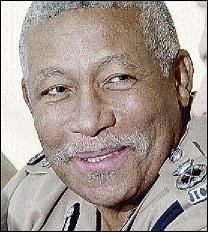
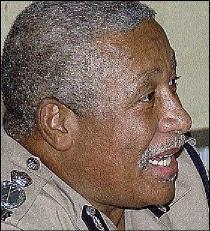
Left: ... I am going to do my best to ensure that this country is liveable. Right: ... We are not going to roll over and die.
Today The Gleaner presents the conclusion of an interview with police commissioner Rear Admiral Hardley Lewin just over a year after his first year as the chief constable. Part one was published yesterday.
Policy direction is key, what's your take on the national security ministry in this respect?
Crime is a multidimensional problem. The police service is one of the critical components that are going to help in dealing with the higher levels of crime. To the extent that I can improve the professionalism and get the police more citizen focused, that is what I am doing. Part of the policy directive is very simple. The policy directive from the ministry is: We will implement the 120-something recommendations of the strategic review. This is three to five years of work and that work is being undertaken. You can never be satisfied with the progress because you always wish that you can be a lot farther than where you are, but I am very encouraged. I am an eternal optimist, you know. I am not going to live anywhere else. I am going to do my best to ensure that this country is liveable.
How has your budget been impacted because of the current constraints?
There are budgetary constraints, and there will be more this year and much of it is not of our doing. The first question is, to what extent are we using our resources to the optimum? There is a slack there that has to be tightened. But you have never seen me publicly coming out with a list and banding that list about as an excuse for anything. You have heard me say from time to time, 'The force has been severely under-resourced over the last 40-50 years. Not only under-resourced, but I dare say undervalued.' But with whatever resources have been provided, we have to treat with it and not forget our international partners. They are extremely important.
We are not going to roll over and die. I think a lot can be achieved if we treat with the human resources and this is one of the areas that I am now dealing with both in the numbers and the quality.
Training can't be compromised. The problem we have is not so much getting the numbers, it's getting the numbers at a rate that exceed attrition. Truth be told, many persons out there come forward, but not all are worthy. Our recruitment is just about the rate of attrition.
Have you been forced to make any changes to your training programme?
We have adjusted the training programme already, because it used to take eight and sometimes nine months to train a recruit at Twickenham Park although the officer will remain on probation for two years on the job. When we examined what was being done at Twickenham Park, I found that we were doing too much, like the high levels of weapons drill and so on. Right now, the training is down to six months. We have had several intakes that have gone through the six months and we are looking now to see if we can turn recruits out in less than six months with more on-the-job-training.
We are looking at creative ways at outsourcing some of the training and ramping up the recruiting. We have revised the whole tutor-constable programme so that training continues once the officer leaves Twickenham Park. We have a problem now and that problem is with the numbers. We have just brought back the beat and foot patrol and we are now seeking to use more civilians to do the jobs that do not require the powers of a constable. We have now identified most of those posts and have communicated to the Ministry of Finance that where there is a surplus in other ministries, we would take them. Out of that process, we would be able to get about 300 more officers on the streets.
Do you reckon that there are enough laws to help the police in their efforts to fight crime?
We are working on a set of proposed laws to present to the National Security Council and we are expecting that things will be taken on board for legislation in the new Parliament. The Proceeds of Crime Act provides a wide base for the police, but the State's apparatus is not sufficient to treat with it. We are embarking on a journey if we are going to deal with crime and violence, not an event.
Is your five per cent murder reduction target for this year on track?
This is too early. This sample is much too small to make a determination.
Is the idea of disbanding the force a knee-jerk call?
It's a knee-jerk call and I forgive anybody who says so. We have to have a new set of laws and regulation and so on governing the new police service, whatever it is called, at the point when the JCF Act is disbanded.
How is the force moving to deal with indiscipline among police personnel?
Police officers are well trained. We have a cultural problem; one of the worst things you could do is to give one of your own some level of superintendence over you. It is like a licence for abuse. To correct the problem, we are not just focusing on the training of recruits, but the in-house training and the leadership within the divisions. We have to identify the people with the propensity to abuse power and deal with them and that is why we have psychometric testing at the medical unit.
damion.mitchell@gleanerjm.com
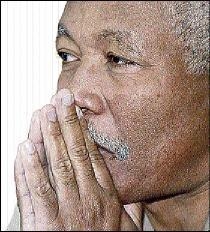
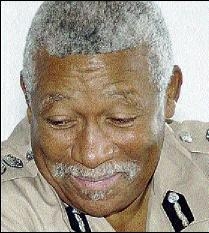
Left: One of the worst things you could do is to give one of your own some level of superintendence over you ... Right:... We are embarking on a journey if we are going to deal with crime and violence, not an event.