
Taitu Heron, manager of the Social Development and Gender Unit, says there is no monitoring mechanism in the law to guard against salary discrimination. - File
Jamaica has a 33-year-old law that mandates pay equality between the sexes, but nobody monitors it even though the sparse information available demonstrates that the gap in salary for men and women remains entrenched.
In fact, none of the agencies that collect information on salaries bother to extrapolate the data based on gender, nor does the Employment (Equal Pay for Men and Women) Act have a monitoring mechanism to ensure adherence to its tenets.
"We have a law that suggests equal pay for equal work but there is no adequate mechanism to monitor it. It can only be measured if an employee finds out that he or she is getting less than another in the same post," said Taitu Heron, manager of the Social Development and Gender Unit at the Planning Institute of Jamaica (PIOJ).
"It is not data which is collected by the ministry even though, as with other legislation, it is something which should be done because the law exists," said Heron.
A waste of time
There is nothing in the law that forces disclosure of salaries, the logical basis on which the equal pay legislation could be properly policed. And, the labour ministry views the issue as 'a waste of time'.
"We do not have one million people working in the department. We are dealing with the things which are affecting people now, including keeping their jobs - sudden dismissals and underpayment for work done," said Michael Kennedy, director of the Working Conditions Unit within the Ministry of Labour and Social Security.
"We do not have time to waste."
Kennedy, who has been director of the unit for the past four years and employee with the ministry for 15 years, says he has never received or seen any complaints relating to disparities in payment between the sexes.
"The law is on the books and if persons want to complain, they can. But as far as we know, there have been no complaints."
Still a tracer study done by the University of the West Indies (UWI) in January 2009 - though not fully indicative of the broader job market nor was it designed for a direct comparison of male-female pay in equal jobs - did find a gap in pay.
The tracer study was also not only confined to Jamaica - 180 of the sample group were non-residents, while 2,464 were.
In a survey of its Class of 2007, UWI found that 71 per cent of respondents had permanent full-time jobs, with men earning an average of $98,194 per month, and women $89,758 per month, a gap of more than $8,000.
The gap translates to just over $101,000, or 8.6 per cent, annually among the UWI graduates.
Put another way, women on average are earning 91.4 cents to every dollar earned by men.
Penal system
Some Jamaican women, however, say unequal treatment stretches beyond pay, including a penal system that often 'taxes' the salary of workers.
Maxine, whose last name has been withheld on request, is a 47-year-old accounting technician in Kingston who has changed several jobs since losing her post in November 2008. She says she has been running the gauntlet, in search of acceptable working conditions.
In one place of work in Kingston, she was unable to stay more than five weeks.
"There was no drinking water.
We had to buy water on the streets. There was nowhere to eat lunch and the floors and phone were filthy," said Maxine.
"They fine you if you come in late; if you request job letter, they charge you $500."
There were also fines for forgetting headwear, ranging between $1,000 and $2,000, that were subtracted from weekly pay.
Melissa, whose last has similarly been withheld, is a 22-year-old who worked long hours for a little more than minimum wage in 2008 before finding another where the male owner did want to pay at all.
She said of this employer in central Kingston: "He hired me as a secretary but used me as a messenger and personal assistant, even to the point of babysitting his children.
"I could not find any time to eat my lunch as he was always calling me. Then he started to make sexual advances and when I rebuffed him he refused to pay me. He wanted me to come in very early and close the shop at night."
That job lasted only two weeks.
Lawmakers get equal pay
Indeed, lawmakers appear to be the only group in Jamaica that do get equal pay. Parliamentarians and the executive branch appear to have the most equitable and transparent structure, with male and female parliamentarians earning $2.5 million per year, while Cabinet ministers earn $4 million.
The elected chamber of representatives is split 52 males, 8 females, while the Cabinet of 17 has two women.
Maxine and Melissa believe their treatment at work is based on two perceptions - that women are 'the weaker sex' and therefore more easily exploited, and that there is no shortage of women seeking jobs, and so are easily replaced.
"I don't know what it is, but men get better treatment. I have male friends who have been absent from work and many other infringements and yet they are kept on their jobs," says Maxine.
Abuse of human rights
Her experience reflects that of women in wholesale/harberdashery establishments on whom a study was conducted June to August 2006 and published on April 29, 2007.
The study involved the interview of nine women aged 18-25.
"There was flagrant disregard and abuse of human rights, such as the right to form and to join trade unions for the protection of one's interests and the right to rest and leisure," the researcher noted.
More recent research indicates that women are more fortunate in landing employment than males, but the data do not capture the quality of the jobs being and comparative pay scales between the sexes.
The Statistical Institute's (Statin) last labour force survey, October 2008, indicates that the number of employed females increased by 9,700 or 1.9 per cent - from 499,800 in October 2007 to 509,500 a year later.
Employed males, on the other hand, decreased by 12,100 or 1.8 per cent - moving from 670,400 to 658,300.
Just one year before this, males were the main contributors to new employment, growing by 11,800 while employed females increased by 7,700 during the period.
Working conditions
The 2006 study on working conditions in wholesale establishments made reference to the difference in wages paid to female shop workers as opposed to males.
"From my experience, men are paid and treated better. There are a lot of young women seeking jobs. They know as they quint they can get another one," says Maxine.
"Men have an attitude of authority that women do not have and get better treatment."
And, even when persons like Maxine and Melissa complain, it is often a wasted effort, according to the PIOJ's Heron.
"Nothing concretely is being done in terms of enforcement. Individuals can make complaints but nothing is done proactively to enforce the law," she said.
"The law is really of no effect."
Still the 1975 equal pay law, which was enacted December 1 that year, stipulates the right to equal pay for equal work between the sexes, where equal work is defined as work which is "similar" or "substantially similar".
Male and female employees under the same employer are accorded the right to equal pay for work that is similar. A contravention of these provisions renders the employer liable to a fine or imprisonment with or without hard labour.
Statin, which collects data on employment, told the Financial Gleaner that it does not track pay based on gender, nor does the Jamaica Employers' Federation (JEF) which conducts an annual survey across sectors.
"The Jamaica Employers' Federation only releases the data, which as far as I know is disaggregated by management level and gender but this is only accessible if you pay (for the survey)," said Heron.
A gender breakout
The JEF said on Wednesday, however, that it does not do a gender breakout, saying it is not a requirement of its membership, a grouping of company bosses.
There are old data in the late '90s, Heron said, which indicated that women then were earning 25 per cent less than men in similar positions.
The Financial Gleaner did locate a 1995 survey that discussed salaries, done by the Gender Studies Unit of the University of the West Indies and presented at a JEF conference in December that year on the 20th anniversary of the equal pay law.
But while in nearly all pay scales there were more men earning higher salaries than women, the study did not compare salaries for like work.
Indeed, the researchers, who were unnamed, said they could come to no definitive conclusion on the data since only 30 men and 49 women responded to the question on salaries.
avia.ustanny@gleanerjm.com
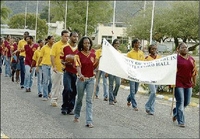
University of the West Indies students commemorating Alumni Week 2006 at the Mona campus in Kingston, in this Gleaner photo of February 16, 2006. The university, in a January 2009 tracer study, found a near nine per cent gap in male-female pay among 2007 graduates. - File