
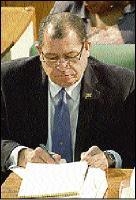
Audley Shaw, minister of finance and the public service, fields questions from parlia-mentarians during a meeting of the Standing Finance Committee in Gordon House last week. - Norman Grindley /Chief Photographer
THE PROCESS of examining the 2009-2010 Estimates of Expenditure is over. The next step now is for finance minister Audley Shaw to indicate how he will be financing his $547.7-billion package.
As the nation holds its breath in anticipation of Shaw's method of financing the proposed spending, the finance minister will have to stoutly defend what now appears to be an incredible budget.
After the three days of examination of the Estimates of Expenditure by Parliament's standing finance committee, we get the feeling that the package is merely an output of a mathematical formula and we would not be surprised if it fails the reality test.
Lacking practicality
Both Prime Minister Bruce Golding and Shaw have said that the budget is a crisis one - designed to eliminate waste, reduce government spending in light of the harsh economic circumstances, while at the same time improve efficiency.
We applaud the good intent but we fear that the estimates' provisions are lacking in practicability. We are baffled by some of the provisions in the budget and the assumptions upon which some allocation are predicated.
For instance, the decision to reduce the allocation to the police for the purchase of tyres, oil and fuel by $92 million. This move is senseless, to say the least. We have a police force that is training more personnel, including 500 district constables, and has outlined plans for increased community policing activities. Yet, the Government is cutting back on the ability of the police to access communities via motor vehicles.
Fiscal tightening
Shaw has said that the Government is using this belt-tightening, fat-trimming opportunity provided by the perilous economic times as an opportunity to set things right. By so doing, he expects that police vehicles will be used less for private purposes and more in the public's interest.
We wish you luck, Mr Finance Minister. But be warned, culture change does not come overnight.
While it is laudable that he is moving to ensure greater efficiency with the use of government-owned vehicles, we fear that the innocent taxpayer will be the victim of his fiscal vice-grip. But the reduction in allocation to the police is just one example.
How on God's Earth does one explain the provision of $310 million to pay for street lighting, bearing in mind that the amount proposed is not even enough to pay the $493 million which is currently owed to the Jamaica Public Service to provide such service.
Reduce utility bills
The Government's move to reduce utility bills in public-sector departments and agencies is also to be commended. We hope it is the case that this drive does not end with the reduction in budgeted amounts but that it is also accompanied by a serious public-education programme.
The fact is that both the JPS and the National Water Commission could get rate increases this year and, if this happens, it means digging deeper into the already dry kitty for funds to pay light and water bills. It would be disgraceful and even chaotic if government agencies cannot afford to pay their bills and the utility companies refuse to supply them.
We hope for the country's sake that the worst does not happen and that Government will be able to stick as close as possible to budgeted expenditure. However, this may be wishful thinking as there are so many incredible figures in Shaw's budget that one gets the feeling he may have to table a first supplementary estimates before year end.
While we wait for the first supplementary estimates to be taken to the House, we cannot help but emphasise the need for our elected representatives to break with some conventions and customs in the way the people's business is conducted.
It is unforgivable and downright disgraceful for government members to go the committee with no other purpose but to shout 'page' or 'ayes'.
We are of the view that Shaw's package was a secret until it was tabled in the house and, even though government ministers would had some input with regard to the allocation, many would have seen the devils in the details only after it was published.
Against this background, we feel that all members of parliament should have found it necessary to examine every line of the budget with a view to ensuring that allocations provided in the estimates can effectively and efficiently fund the programmes of the Government.
It should not be left up to the Opposition alone to probe the proposed spending. All members of the House have a responsibility to ensure that the country's resources are being allocated in the best possible way.
Although some members of the Opposition were disciplined, dedicated and prudent in their examination and questioning of the estimates, we would have loved to see a more prepared and clinical Opposition probing Shaw's wishful package.
Simpson Miller's gaffe
Meanwhile, The Gavel would be doing the country a disservice if it did not fall on Opposition Leader Portia Simpson Miller for spoiling what seemed a creditable performance in examining the estimates through her ill-advised attire in Parliament last Thursday.
Simpson Miller stood up for the poor and disposed in the committee and was strident and uncompromising as she argued against any cut to areas that she believed would affect society's most vulnerable. In fact, she was like a scratched record - all for good reason.
However, her contribution to the deliberations may be remembered for her inexplicable decision to break with convention and wear denim to the people's Parliament.
We are disappointed with you, Mrs Simpson Miller. There are but a few persons in this country who dress as well and as appropriately for events as you do and, when you set high standards, you are expected to live by them.
It's not a case of much ado about nothing. Just imagine if Prime Minister Golding had worn a denim suit to the committee? Inappropriate, wouldn't you consider it?
Send feedback to thegavel@gleanerjm.com