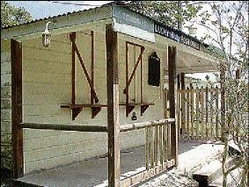
The Lucky Hill Post Office as photographed in March 2006. - Ian Allen/Staff Photographer
A couple of miles south of Gayle in St Mary is a little town named Lucky Hill. Lucky Hill is about five miles as the crow flies dead east of Walkerswood in the neighbouring parish of St Ann.
A cooperative farm has been at Lucky Hill since the 1940s and still survives in some sort of way today. I mention Walkerswood because the Lucky Hill Cooperative Farm did not originate from within St Mary but the idea was transplanted there from Walkerswood, St Ann.
The idea of a cooperative farm sprang out of the convergence of a number of factors towards the end of the 1930s. While we are more familiar with the labour unrests of 1938 on the Kingston waterfront and in the sugar belt of Frome, Westmoreland, the poor, landless people of Walkerswood, in the ferment of the times, independently made their own 'land-hunger' march from Walkerswood to Moneague.
And the year before, 1937, Norman Manley had-founded Jamaica Welfare Limited with financing from the booming banana industry.
Bromley estate
A third factor was what was happening at the Bromley estate, a John Pringle property in Walkerswood. Sir John's daughter, Minnie, had inherited the place from her father. Miss Minnie, as everybody called her, a second-generation white Jamaican, her father having migrated here from Scotland, was a social activist in the vein of Fabian socialism.
Through her own daughter, Fiona, she had come in contact with moral rearmament (MRA) out of England. Bromley became a centre for MRA meetings, for development activism and for devotion. The estate workers and other villagers met at Bromley, for part-devotion, part-development scheming, and part-political activity in the broadest sense.
Norman Manley, of fellow Fabian socialist stock, development activist through Jamaica Welfare, and the emerging chief political leader (the PNP was founded with him as leader in September 1938) found a welcome at Miss Minnie Simson's Bromley.
Jamaica Welfare had recruited D.T.M. Girvan as its first development officer. And, Girvan was on the lookout for opportunities to implement his unfolding ideas for development led by Jamaica Welfare. The gatherings at Bromley involving estate workers and villagers, to which his boss had introduced him, presented just such an opportunity.
Girvan organised the first Pioneer Club in the country at Walkerswood in 1940. The idea of the Pioneer Club, Girvan's brainchild, was to spearhead rural development by formally bringing villagers together to help themselves in areas of need such as housing and land preparation.
His wife, Rita, recounted to their son, Norman, the story of the origins of the first Pioneer Club: "We knew Mrs Simson of Bromley, near the village of Walkerswood. There were these two men from the village, Peter Hinds and Alton Henry," she told him.
Sunday morning prayers
"They used to come to Mrs Simson's every Sunday morning for prayers, and right after prayers Thom would start talking to them and asking them what were their greatest needs. Out of that he formed the Walkerswood Pioneer Club with the two men as leaders. One of them was literate; the other barely so but with a fantastic brain, and both became leaders.
The Pioneer Club decided that what they needed was land to farm for themselves, Miss Rita recalls. "Thom got together with some other people and made recommendations to the Government and so the Lucky Hill Farm was bought by the Government for these people. The members of the Walkerswood Pioneer Club started to operate the Lucky Hill Farm and set up a cooperative farm that still exists today."
Beginning with the Walkerswood Pioneer Club, D.T.M. Girvan's work in rural development was guided by what he called 'The Better Village Approach' (later modified to 'The Better Community Approach').
A few years ago, I had the privilege of capturing the Lucky Hill Cooperative Farm story as part of the story of community development in Walkerswood in a big meeting at Bromley with surviving pioneers, children of pioneer, staff of Walkerswood Caribbean Foods, a company which came out of that story, and members of the Pringle-Simson-Edwards family.
One pioneer, Victor 'Vicky' Henry, had "always been wondering why Bromley and the Walkerswood story are not mentioned in the pages of history. The Pioneer Club movement began here at Bromley," Vicky insisted. Norman Manley himself and Thom Girvan "came down to Walkerswood and the Pioneer Club came out of Jamaica Welfare".
'Better Village Approach'
Applying the Thom Girvan 'Better Village Approach', a dozen men became the foundation members of the Walkerswood Pioneer Club meeting at Miss Minnie's Bromley. Alton Henry and Peter Hinds emerged as leaders. The last surviving one of the 12, Ewan Nelson, was at that meeting,
The first land of the Walkerswood Pioneer Club was donated by Allan Keeling in Walkerswood itself, the site of the Baptist church today. Their first project was a lime kiln on that land. The hard work without direct personal ownership in the cooperative model led some participants to declare, "Dis look like slave business", and they backed out.
The search for more land led to nearly 800 acres at Lucky Hill in the neighbouring parish of St Mary, just across the parish border, five miles east of Bromley.
The Second World War was on. Shipping faced the hazard of German submarine attacks. The country, therefore, adopted a plan for self-reliance in food production. Richard Williams, who was bookkeeper for the Lucky Hill property, was placed in charge of overseeing the national food-production plan. Jamaica Welfare - Girvan and Manley - approached Williams about purchasing the land for a cooperative farm for the Pioneer Club of Walkerswood under the food-production programme. The Government bought the Lucky Hill land and the club was given a 99-year lease which is still in force.
'Out to build a new Jamaica'
'New Jamaica' was the second project of the Walkerswood Pioneer Club, this time at Lucky Hill. The project was a big lime kiln, so named by pioneers who were "out to build a new Jamaica". And the quick lime produced did come in handy for the building projects on the first cooperative farm in Jamaica. Pioneer families constructed their own houses by cooperative labour. But one of the first buildings to go up was 'Put Good', the communal meeting place and storage area and centre of operations for the cooperative.
Each family was assigned 2 1/2 squares of land and later five squares, the rest of the property being cooperatively farmed and managed. The land was divided into five sections with five according leaders. Over the entrance to the property, a proud sign announced its official name: 'LUCKY HILL FARMING COOPERATIVE SOCIETY'.
High moral standards
Couples had to be married to join the cooperative and be assigned housing on The Lucky Hill property. In one particular year, six couples were married. Ewan Nelson recalls the eviction of an unmarried man caught with a woman on the property. The marriage rule reflected the high moral standards that the cooperative held in its operations. Lucky Hill was crime-free woth no praedial larceny.
The co-op established its own infant school. Sunday school was also held. Co-op members belonged to different churches but would all meet for a common Sunday school before church services, in the spirit of the non-sectarian MRA.
Cooperative members were paid a basic wage and obtained free milk with a few other cooperative benefits, but raised their own crops and animals on the assigned plot. The Jamaican tradition of 'morning work' was used for clearing and planting and building on the family plots.
Pioneers walked or rode donkeys the five miles between Walkerswood and Lucky Hill, Mondays to Fridays, before houses were built, or if they did not have a house on the property.
It was not all work. The Walkerswood Pioneer Club sponsored cultural, social and sporting events. All-island sports days saw all 14 parishes coming in to participate. There was a cricket club, sponsored by Mrs Simson, with a field on Bromley land.
The Lucky Hill Cooperative Farm has struggled on for nearly seven decades but things and times have changed.
Martin Henry is a communications consultant, university lecturer and columnist with The Sunday Gleaner.