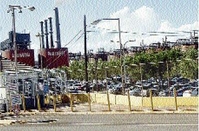
A view of the Alpart bauxite plant. - Norman Grindley/ Chief Photographer
Slide in prices
1. Jamaica's bauxite and alumina industry is undergoing its worst crisis since the 1980s, brought on by the collapse of demand for aluminium products and the consequential slide in prices. These products are essential raw materials for a wide range of industries which are being buffeted by the global economic recession. As demand for aluminium has fallen, producers have been forced to carry out cutbacks at smelters and alumina plants internationally to counteract the build-up of excess supply.
Expensive capacity
2. The companies are experiencing a sharp deterioration in their financial situation and have had to rationalise their production by closing more expensive capacity. Jamaica's alumina plants, which are among the higher-cost capacity, have, therefore, been more vulnerable.
Already, the two Windalco alumina plants have been closed and the Alpart plant, the largest of four on the island, will cease operations on May 15. These closures are being undertaken to reduce the excess supply of alumina within the systems of UC Rusal and Hydro Aluminium, the owners of the plants.
Lone exporter
3. The curtailment of aluminium and alumina output has also affected St Ann Bauxite Company, the lone exporter of crude bauxite on the island. The company has announced a 30 per cent reduction in 2009 as its customers in the US have cut alumina production.
All told, the local plant closures will result in a 50 per cent fall in bauxite production to eight million tonnes. Alumina output is projected to decline by nearly 60 per cent to just under two million tonnes, which will be lowest level seen in more than 20 years.
Further decline
4. The full impact of the closures will be felt in 2010 when bauxite output, assuming that the Jamalco plant and St Ann Bauxite Company continue to produce at current levels, could slip to less than seven million tonnes. With the Jamalco plant alone in operation, alumina production would decline further to about 1.5 million tonnes.
Significant challenges
5. The companies have announced their intention to halt capital projects for the time being and, along with the scaling down of production, this will result in a drastic fall in net earnings to around US$190 million or about one-third the level for 2008. Gross foreign exchange earnings are also set to fall dramatically, from about US$1.3 billion in 2008 to less than $450 million in 2009, posing significant challenges for the balance of payments. The implications for the exchange rate and the country's foreign reserves are grave, especially bearing in mind that the plants are not slated to reopen before the next two to three years.
Gross earnings
6. To be sure, both gross and net foreign exchange earnings will decline further in 2009 as alumina prices are anticipated to remain depressed due to weak market conditions and low aluminium prices. Gross earnings could fall to about US$360 million and net earnings to no more than $100 million.
Bauxite communities
7. The announced job cuts at the affected alumina plants and St Ann Bauxite Company are expected to reach over 1,000, which does not include those that will result from the impact of the closures on local suppliers of goods and services to the industry. Bauxite communities in St Elizabeth, Manchester, Clarendon and St Ann are going to see a downturn in business activity resembling the fallout that occurred in the 1980s.
Depressed levels
8. Government revenues from the bauxite industry, including bauxite levy, corporate income tax, PAYE income tax, statutory deductions and other revenues to government, which stood at US$ 898.7 million in 2003, had reached US$133.6 million by 2007. It slipped to US$1221.8 million in 2008 and will plummet to less than US$40 million in 2009 because of the drastic cut in production described above. There is no likelihood that government revenues will recover from this depressed level in the short term since the operators of the Windalco and Alpart plants have signalled that there will be no quick reopening.