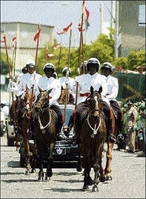
The pomp and ceremony of Parliament's first day is always something to behold. That fact is not lost on the officers who formed part of Governor General Dr Patrick Allen's motorcade in downtown Kingston yesterday. - Ricardo Makyn/Staff Photographer
The golding administration yesterday made the first step towards keeping its pledge of austerity management this fiscal year, presenting a Budget that, in real terms, is about four and a half per cent below what the Government spent last year.
The $548-billion spending package that Finance Minister Audley Shaw tabled in House of Represen-tatives is nominally $48 billion, or eight per cent more than the $508 billion that was the revised figure for the 2008/2009 Budget.
But the increase is before inflation - estimated at around 12.5 per cent for the fiscal year - is taken into account. Given that movement in consumer prices, the Budget that is allocated will buy nearly five per cent fewer goods and services than would have been possible in the last fiscal year.
All sectors feel pinch
All sectors and ministries will feel the effect of the belt tightening, the need for which was exacerbated by the global economic crisis that has hit Jamaica hard. Somewhat surprisingly, nonetheless, tourism, considered a key engine of the economy, took a big hit with its recurrent budget slashed by approximately 30 per cent to $3.5 billion.
But, as would have been expected, the effect of Shaw's scalpel, based on the gross numbers, is most immediately obvious on the capital side of the ledger where many projects will either not start or have to slow down.
The capital budget, at $191 billion, is $7 billion or approximately four per cent lower than last year's allocation - and that is before the effects of inflation are factored in.
On the recurrent side of the ledger, which covers the normal housekeeping activities of the Government, the allocation is $356 billion, up $47 billion or 15 per cent on last year's budget. However, $159 billion, or 45 per cent of that amount, will go to pay interest on Jamaica's debts, which is covered from the recurrent account. Last year, interest costs were $124 billion.
Recurrent payments
That leaves only $197 billion for all other recurrent payments, including public-sector wages and salaries, most of which Prime Minister Bruce Golding said would be frozen this fiscal year.
Of the discretion that is available to the Government, the Ministry of Education gets the greatest chunk - $68 billion of 34.5 per cent of the non-debt recurrent budget. That is a rise of 13 per cent, marginally above the rate of inflation.
In real terms, the real winner with regard to recurrent spending is the national security ministry, whose allocation of $40 billion is up five and half billion, or nearly 16 per cent more than last year. The health ministry's recurrent budget remains flat at $29 billion.
The losers on the recurrent side include the Ministry of Tourism, which sees its housekeeping budget reduced from $3.5 billion to $2.7 billion, while the allocation to the Office of the Prime Minister for local government has been slashed by almost $1 billion.
Gov't funding
On the capital-side budget, the Government expects to itself fund 89 per cent of $170 billion of the proposed expenditure - down from $180 billion last year - while bilateral agencies are expected to pump $21 billion into local projects.
But even that masks the gravity of the situation for repayment of government debt, which also captured on the capital side is $150 billion, up from $144 billion last year.
The $7-billion reduction in the money the administration will spend on projects this year reflects a three per cent cut in capital outlay when compared with last year. In other words, the Government will have only $41 billion on capital projects.
Zero capital for tourism
Among the state agencies which will have to cut down or eliminate capital spending this year is the Ministry of Tourism, which has seen its $53-million capital provision from last year cut to zero in this year's Budget.
The Ministry of National Security, which was given $2.8 billion for capital projects last year, will now have to make do with $2.2 billion, while the Ministry of Industry, Investment and Commerce, which had a capital budget of $450 million last year, now gets $250 million.
The big loser on the capital side is the Ministry of Transport and Works, which had its budget slashed by 35 per cent, or $1.4 billion, to $3 billion.
A closer look at the figures for the Mike Henry-led ministry shows the money allocated for disaster management being cut from $2.9 billion to $1.7 billion, while money to fix roads, river training and gully cleaning has also been reduced significantly.
arthur.hall@gleanerjm.com