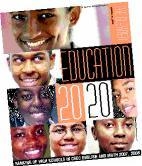
The Gleaner's annual Education 2020 magazine leaves a lot to be desired. The ring of failure runs through the pages. Here are some of the concerns that must be noted:
1. The contributors:
Bill Johnson, political pollster, has now suddenly become an educational statistician. There is (little) rationale or explanation for the statistics quoted and his article is full of the concept of failure and is laced with the vulgar statement: "... a 54 per cent 'pass' rate in English and 43 per cent in math". It is about as meaningful as saying that the 'average' Jamaican has one breast and one testicle.
Maxine Henry-Wilson states that the education system requires emergency treatment now. This statement after being a minister of education for many years and being part of a ruling party's running of the system for 18 years. The very comment is shameless, hypocritical and lacks credibility.
Raymond Chang contributing from the safety of Canada and as president of Ryerson University, lectures the country about more resources for education and that the education system is failing Jamaica. Let's have his solutions and help.
Robert Wynter at least has some creative ideas which can be taken on board. Perhaps the ministry can enlist his aid.
2. Historical realities
The new secondary schools - One of the historical realities that needs to be pointed out is the establishment of the so-called non-traditional schools. These schools were established in the '70's as an offshoot of the free-education policies of the Michael Manley government. Two grades were added (Grades 10 and 11) to the then existing junior secondary schools which ended at grade nine. The schools were called new secondary schools. A new examination was developed for the schools called the Secondary School Certificate (SSC). The examination was supposed, but failed, to be equivalent to the then existing CXC examination. Thus was created a parallel and second-class secondary system which remains a legacy to this day. Their performances show up as they are struggling to catch up with the traditional secondary system after being integrated under the incumbency of Minister of Education Burchell Whiteman.
The technical high schools - These schools are also selected for poor performance. One of the reasons for this is that the comparisons are not fair in terms of student learning time.
The traditional and now the non-traditional get students on the basis of the old Common Entrance Exam, now the Grade Six Achievement Test, at grade 10/11. They have five years to study for the CXC exams.
The technical high schools get their students largely through the Grade Nine Achievement Test and therefore have two years of study to take the same exams. It is an apples and oranges comparison.
The school-placement system: The Biblical principal prevails to the present time with the leading traditional schools getting the pick of the high achievers in the GSAT examinations. This is not to gainsay the quality of leadership that was for example provided at Campion College by Radley Reid for many years.
The school location: Many schools that are ranked as performing badly are located in war zones and the children have to face the trauma of crossing party zones and generally being traumatised by the school's location.
3. A different mind-set:
No one could seriously argue that there are not serious weaknesses in the education system. But we need a different approach in some of the following ways.
Parental responsibility: The role of the home in the development of a child is critical and our parents are failing badly. Here is where the society can help to generate the sense of responsibility of our families.
Recognition of success: The recognition of those who have made a difference in education is critical. Take the case of Esther Tyson, the legendary head of Ardenne High, whose courageous attack on the dancehall culture has led to the Broadcasting Commission finally acting against this pervasive filth over the airwaves. There are thousands of leaders and teachers who are doing a fine job
Recognition of achievement: There are many examples of fantastic achievement of our students at schools. Take the achievements in athletics and sports in general, the successes in the CXC examinations and more.
4. Using only mathematics and English:
Johnson has joined Dr Ralph Thompson in his ranking of schools based only on English and math. While there is clearly an important role to play in these subjects, school is a lot more than that. The building of character, the relationships that are a part of life are what school is about.
Dr Alfred Sangster, an educator, is former president of the College of Arts, Science and Technology (CAST), now the University of Technology.