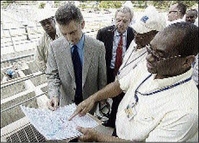
Garth Jackson (right), senior project manager, National Water Commission (NWC), outlines to Russell Hadeed, NWC chairman, the communities to be linked to the New Kingston Metropolitan Area Water Supply Plant. The first phase of the project, based in Job Lane, Spanish Town, St Catherine, was completed at a cost of US$2 million. - Ricardo Makyn/Staff Photographer
The world is spending one-fifth of its GDP (US$12 trillion) on projects this year - and organisations ranging from global businesses to governments to NGOs - have identified this area and skilled project managers as the key to their success.
In Jamaica, project management is an in-demand career and can be found in many sectors, such as government, socio- economic development, technology, consulting, construction, services and research, among others.
Globally, employment is also available with international organisations such as the United Nations, the European Union and the United States Agency for International Development. Sources from the World Bank note that more than one-fifth of the world's GDP (US$12 trillion) is currently spent on project-based work. The US-based Project Management Institute (PMI) has projected that by 2013, there will be a shortage of six million skilled project-management practitioners.
There are several opportunities in project management, including as a project manager, a project team member, a project risk-management professional, or a project-management scheduling professional.
Locally, there are concerns within the profession that there are not enough skilled persons to meet the demand. Here is an excellent opportunity for persons to pursue a career change or a new career that is bound to be rewarding and exciting.
Surprisingly, there is no basic requirement to work in the field of project management and so transition into this field is fairly easy. However, if you would like to acquire certification/credentials in project management, you will at least need a high-school diploma/certificate and 23 hours of specialised project-management education, such as that offered by the local arm of the PMI and the University of Technology, among others.
Global standards

Lobban
This project-management education must be according to global standards. Another basic entry-level requirement is 1,500 hours of project-management experience.
These basic qualifications will make you eligible to gain credentials as a certified associate in project management. You may also wish to be a specialist, such as a project-risk professional or a scheduling professional. Project-specialist practitioners are important to project management and assist the project manager to effectively implement projects.
To become a certified project manager you will need to acquire 35 project, management hours, as well as to have a first degree. You may also ultimately handle multiple projects as a programme manager.
Experience is a critical step in becoming a certified project-management practitioner. So, if you would like to start in this field, work or volunteer in areas and organisations that implement their work using projects. Examples are NGOs, banks, government, international development agencies, consultant firms and universities.
Sherrone Lobban is lead consultant, Development Partners and Management International. Email slobban@dpminternational.com.