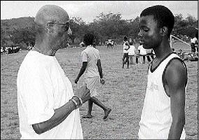
Byron Labeach (left), one of Jamaica's first Olympians, speaks to Huge-George Watson, a fellow athlete. Watson was the Class Two winner of the 100-, 200- and 400-metre races at the Jamaica Teachers' Association Trelawny Athletics meet at the Muschett High School on Tuesday. - Photo by Richard Morais
Lucea, HANOVER:The 1952 Helsinki Olympics signalled the start of Jamaica's magnificence on track and field's world stage. It was at those games that Herb McKenley, Les Laing, Arthur Wint and George Rhoden became iconic figures. There was a fifth member of that gold medal winning 4x100 team who didn't become an icon.
Byron Labeach, an alternative member on the gold medal team, proved his worth on the world scene at the 1954 Central American and Caribbean Games (CAC) in Mexico where he earned his only gold medal for Jamaica in the 4x100 metres. His teammates were Les Laing, George Rhoden and Keith Gardner.
Labeach told The Gleaner that though he never got the chance to run on the team to the '52 Olympics, his training was similar and he would have done well had he been given the opportunity.
He ran in the 100 metres in the games but did not make the cut for the final. Naturally the mention of his name today comes with a question sign - 'la-wha'?
The 77-year-old Labeach is in the island to attend the Issa/GraceKennedy Boys and Girls' Athletic Championships and The Gleaner caught up with him at the Jamaica Teachers' Associa-tion Trelawny Athletic meet at the Muschett High School on Tuesday after an invitation from fellow Olympian Pablo McNeil.
misinterpreted rules
Labeach never competed for Jamaica again. Though he was still qualified to run, Labeach's entry into the United States Army created a situation where he was not picked to run at the '56 games in Melbourne, Australia. Apparently, Jamaican officials misinterpreted rules about eligibility and he was not considered. The rumour going around at the time suggested that Labeach did not run because he could not afford the fare to the event. Though the memory of his exclusion was painful, the mention of the rumour brought laughter from the former Olympian.
So painful, in fact, was his exclusion from the '56 games that Labeach gave up any further attempts to run for his country and retired at 27.
He went into education and gained his master's in business and started a food-processing business and was one of the first persons to import authentic Jamaican food into the US in the '60s.
Today he is a consultant but is also part of an organisation which helps primarily Jamaican athletes. He said that while celebrated athletes are often in the news, there are those who quietly need assistance.
- Richard Morais