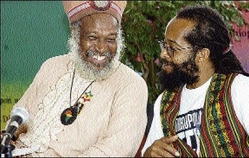
Miguel Lorne (left), attorney-at-law, shares a joke with Dr Michael Barnett, lecturer at the University of the West Indies, during a public discussion on the Global Capitalist Crisis and the search for solutions, held yesterday at Liberty Hall, downtown Kingston. - Norman Grindley/Chief Photographer
A university lecturer says Jamaica has to break the cycle of dependency if it is to recover from the economic downturn.
"We have to be creative in removing ourselves from this dependency syndrome," Dr Michael Barnett, lecturer at the University of the West Indies (UWI), Mona, said during a public discussion, held at Liberty Hall, downtown Kingston, yesterday.
"We need a sense of vision, we need a plan, we need to think long term," Barnett said during the session titled 'The Role of Reparations and Pan Africanism in Economic Recovery'.
Pointing to China and India, which have vibrant manufacturing sectors, he noted that Jamaica had to move in this direction if it were to survive.
"We need to be cognisant that the West has its matter to be preoccupied with. This is why it is very important that we do not rely so heavily on foreign loans," he said.
Barnett said Jamaica had to become self-reliant and produce more of its own food. He also suggested that a higher volume of trade take place among Caribbean countries.
More proactive
"We need to be more creative. We need to be more proactive in forming our economic relationship," he said.
Meanwhile, Cecil Gutzmore, another lecturer at the UWI, said the current economic crisis has revealed that reparation can be given to Jamaica for the atrocities of slavery.
"Reparations are not as unaffordable because capitalism can generate the money. It generates it when it is in their interest," he said, pointing to the billions of dollars that have been given to financial institutions to bail them out of the economic crisis.
Attorney-at-law Miguel Lorne urged Jamaicans to intensify the call for reparation.
He noted that this compensation could be a start to a genuine independent recovery.
Meanwhile, Lorne chided the Government for its failure to include persons he deem have intimate knowledge of reparation on the Reparations Committee.
Cabinet in January approved the commission, to be chaired by university Professor Barry Chevannes. Other members include Lord Anthony Gifford, Professor Rupert Lewis and Robert Miller.