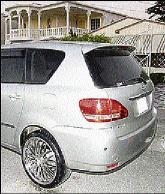
A Toyota Ipsum with 20-inch alloys.
Most people like to roll in a nice looking car but with the foreign-exchange rate where it is - coupled with the fact that Jamaica doesn't really make any of the pretty stuff locally - a set of 24" spinners can cost as much as a deportee nowadays. What's a hot rodder to do?
On a budget of $150,000, it STILL can be done (nobody said cool was cheap)! Proper attention to what matters, with an eye for the frugal, tempered with a classic sense of style, plus a never-say-die attitude, is a recipe for a one-of-a-kind ride that will turn heads and increase the equity in your car to boot! There are three areas to improve on: wheels and tyres/suspension, in car entertainment, and lastly, paint and body. With a budget of about 50 grand per category, you, too, can snap heads.
A car is mostly a visual experience. Any tuner-car worth modding has lines that flow from front to rear - unbroken by doors, wing mirrors or wheel arches. That's not to say that one can't pimp an Isuzu Bighorn - it's just harder to do. Rides like the Toyota Celica or 1993-1995 four-headlight Honda Integra lend themselves to the hot rod look - in that they look fast even when standing still. Complement these classic flying-wedge shapes with the right wheel and tyre combo and you're off to a good start.
Plus-sizing your rolling stock will add that rad look to your ride without hurting your head when it comes to alignment time. The goal is to fill up as much of the wheel well as possible - especially to decrease the space between the fender lip and the top of the wheel. Some tuners go as far as to spread the fender, so as to get the wheel up in the fender without rubbing.
As with everything else in life, one can go too far. The 35- and 40-series tyres almost always dictate a harsh ride and, because they are not a mass-market tyre, they tend to be hugely expensive. Also, 24" alloys are okay - if you're customising an H2 Hummer.
Functionality borderline

A pimped-out Toyota Scion.
SUVs aside, these huge wheels look out of place on anything except the very largest old-school American cars. Their size makes their functionality borderline as the tyres used have sidewalls sometimes less than two fingers thick. On Jamaican roads, one has to question the viability of such a set-up. But they do look cool.
This writer thinks that installing anything over 18-inchers on a road car is overkill and is beyond the scope of this article. Sticking with 18s means savings, as a set of these rims goes out the door for maybe 30 grand - compared with $400K for a set of 24s. Even twenty inchers are pricey - a set can deplete the pocket as much as eighty grand - and that's WITHOUT tyres.
Choices, choices; to spruce up your ride, you need those rollas, man. To get the most for your hard-earned bucks, choose wheels with a six-spoke design or greater, as these tend to be stronger - a key attribute for survival on Jamaican roads. The lighter the better - for fuel economy, ride quality, performance and handling.
After you've chosen your wheels, the next thing to look at is stance (that clearance above the top of the wheel thing). Most folks just cut the spring to achieve the desired ride height. However, according to Tyre Warehouse's Rohan White, "Cutting the spring increases the spring rate, overloads the stock shocks and puts additional stress on the body of the car. The best route to lowering ride height is by using aftermarket lowering devices such as TEIN springs, as they combine more coils per inch with a shorter length, achieving the desired ride-height with a progressive spring rate. Coilover units can also be used but they are usually more expensive."
So, contrary to popular practice, do not cut or otherwise shorten your stock springs!
Next week: Sounding Good
mario.james@gleanerjm.com