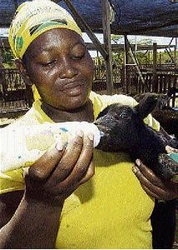
Karlene Findlay feeds an orphaned lamb from a bottle. Otherwise, these lambs would not get enough milk to survive. - photos by Ricardo Makyn/Staff Photographer
SOME PEOPLE count sheep to fall asleep. For farmer Donnie Bunting at Longville Park Estate in Clarendon, counting his herd has nothing to do with rest; the almost daily routine is all about work.
Once a lamb is born, its date of birth is recorded and it's assigned a number which indicates the number of female and male lambs born since the start of the year.
They are then tagged through an ear and the process of removing the tails of both sexes and the testicles of the male lambs begin.
The tails and testicles are removed through the bloodless processes, docking and castration respectively. An instrument called an elastracator, which resembles a rubber band, is used to wrap around these parts to cut off blood supply to the areas, causing them to wither away over time.
After the intake process, the young animals go back to the claiming pen to get to know their mothers. They are eventually separated and the mothers go back to the big breeding flock; the male lambs go into the male lamb pen and female lambs the same.
High-quality lamb
All these processes prepare the sheep to be part of the well-oiled machine of producing high-quality lamb.
But already into fish farming, Bunting's involvement almost never happened as he sort of stumbled upon the business of sheep rearing.
"Fish farmers have a problem: an abundance of growth of grass around the pond's banks. So they always spend a lot of money to chop down the grass which prevents access to the ponds," Bunting said. With a thriving fish-rearing business in Longville Park, Clarendon, he was no exception. Almost at the end of a process of selling off an unruly herd of goats, another farmer offered to trade him his remaining goats for nine sheep.
"I took the nine sheep and bought a ram from somebody else," said Bunting, who was formally trained at the Somerset College of Agriculture and Horticulture in England. "They started to multiply and they did very well. They stayed at the pondside and ate down the grass. So they grew and grew until I found myself at one point with 650 sheep, but we never did anything with them, their sole purpose was to eat down the grass," he said.
The dutiful sheep saved him the labour and machine costs involved in cutting down the overgrown grass. He was pleased, until one day a thief stole a number of the animals. Unable to get justice through the law, he decided to part ways with the animals.
"I got frustrated and started selling them off. When I was down to 50, I got a telephone call from Ruth Simpson, cluster facilitator for the Private Sector Development Programme (PSDP). She said, 'We're starting a sheep farming association, do you have any sheep left?'" Intrigued, he decided to keep the 50 and became further interested when they talked about importing Dorper rams, a premium cross-breed sheep, to help in the rearing of lambs for eating. He subsequently became the association's president.
Now, close to the end of his tenure as head of the Sheep Farmers' Association (part of the Small Ruminant Association), Bunting said the group is endeavouring to take sheep rearing in Jamaica to a higher level, producing the animals for consumption. He pointed out that sheep are more viable, producing more meat than goats and providing a good option for Jamaicans.
Ongoing research
The Sheep Farmers Association, which started approximately three years ago, comprises 42 farmers and aims at making the business profitable for all involved. It is funded by the Agriculture Special Services Project and each member contributed cash, kind (sheep) and labour at the start. The PSDP funds the development of ongoing research and promotional activities.
The PSDP uses funds from the European Union for export-replacement projects such as sheep rearing. The funds also help with training to get more expertise in the industry. In the near future, there will be a processing room, storage facility, packaging machine and grinder at the association's farm located at Bodles in St Catherine. Bunting said they also need a smoker for the popular smoked leg of lamb. Currently, the farm operates with the following facilities; a chill room, feedlot, slaughtering facility and freezer.
Bunting continues to explore his options. He sells his lambs primarily to hotels and also produces a variety of premium sausages.
Today, Bunting's dutiful sheep are continuing where the goats left off - keeping the grass low.
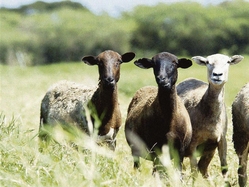
No, they are not looking for Little Bo Peep, they are curious to know who are the strange two-legged creatures from The Gleaner who dare to interrupt their afternoon graze.
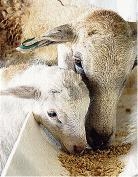
A ewe and her lamb at feeding time.
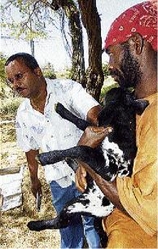
Donnie Bunting (left) isolates the testicles of this lamb to begin the process of castration while Lawrence Findlay holds the animal. An elastracator band (resembling a rubber band) is put around the scrotum to cut off its blood supply. They will wither away over time. Part of the animal's tail is also removed using the same process. Tail removal facilitates easy mating.
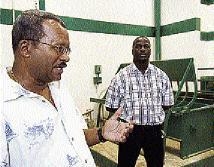
Donnie Bunting (left), owner of Longville Park Farm in Clarendon and president of the Sheep Farmers' Association, and Loren Thomas, the association's project manager, show the Lifestyle team the abattoir. The Sheep Farmers' Association is a part of the small ruminant cluster which is funded by the Private Sector Development Programme, co-founded by the European Union and the Government.
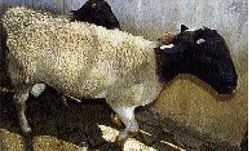
Dorper sheep, such as this one, are used exclusively for breeding.