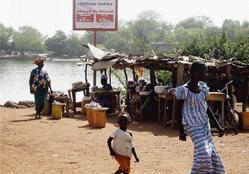
Women selling kuskus (made from cassava) at the riverside.
Jamaican Teko Bailey recently made a six-month trip to Sierra Leone as a missionary. Here is his remarkable journey.
Sierra Leone has suffered the ravages of 10 years of civil war. The capital, Free Town, inherited its name from the British monarchy as the first set of freed slaves were released there. In the provinces, there are tribes which have not yet heard of Jesus. In June 2008, I answered God's call to go into the world and make disciples, and went to live among the Susu tribe of Sierra Leone.
My journey began at Youth With A Mission (YWAM) where I work as a full-time voluntary missionary. YWAM is a non-profit voluntary Jamaican Christian organisation and a branch of Youth With A Mission International. It has operated in Jamaica since 1985. The organisation's main objective is to train and mobilise young people to serve the poor, youth and those who have never heard the message of Jesus Christ.
All YWAM staff are volunteers. No one get a salary but are sponsored by friends, families and home churches.
The directive
God wanted me to go to Sierra Leone, specifically to the Susu tribe to live and, with his help advance their welfare.
There were challenges and, up to two weeks before my departure, I still did not have all the finances for airfare, ground transport and accommodation. A special offering was collected at church and, with help from my sisters and friends, I was all set.
I arrived at the Lungi Airport in Sierra Leone on a dark Wednesday night and travelled to Free Town on the ferry. It was the beginning of the rainy season. I stayed in a little guest house in the heart of the city for about three weeks to become acclimatised.
There were similarities and differences between our two countries. For example, I'd never seen bread sold in newspaper and it took me weeks before I could get used to eating the famous Tapalapa bread, similar to our mongoose bread, but nicer.
Though each of the 17 tribes found in the country have their own dialect, there is a common language of trade called the Krio, which sounds similar to our Jamaican Creole, that I was able to catch on.
Some mornings, I woke up and wondered where I was and what was happening around me. The Muslims prayed five times daily, starting minutes before six in the mornings and loud enough to disturb any giant's sleep. They came out in the hundreds for prayer call to Allah and the sounds and chanting they made were very strange to my ears.
Meeting the Susu
In my third week, I headed north in search of the Susu people. My local guide had never been to that side of the country before but agreed to accompany me. It was a wet muddy morning as we boarded the Poda-Poda (minibus) which is about 10 times older than ours with hardly anything to cushion the body.
On the drive through the villages of Kambia, Port Loco, Masiaca, and Madina, I saw mud brick houses with thatched roofs and malnourished children running around. From a distance, the children spotted me and cried "Apoto! Apoto! Apoto!" meaning 'white man'. To them, I'm not 100 per cent black. This surprised me.
Illness
Passing through the deep rural bushes where the men work the land, farming millet, cassava, rice, peanuts and other staples, I saw women with their katas, used to cushion the head, walking many miles to sell their produce. The mosquitoes are abundant and spread malaria, which I caught along with typhoid fever for a few weeks.
I finally arrived in Kukuna early on a Thursday morning and was directed to the paramount chief of the village. I was scrutinised from head to toe and had no idea what to expect. For a while, the locals spoke amongst themselves in their dialect then, to my surprise, invited me with a village ceremony.
They asked me why I had come and I told them I was sent by God. The Susus are known to be hardcore Muslims. I gave it to them straight, I said, "Jesus loves you and he wants you to know who he is that's the reason I'm here". By this time, I was surrounded by almost the entire village.
The section chiefs asked me why I bypassed Free Town, Port Loco, Kambia, Madina and their villages to come to them? I told them that there are persons in Jamaica who have been praying for them and Jesus loves them. They were overwhelmed by this. The chiefs said that for hundreds of years they had followed the Islamic religion and had gained nothing and it was time they opened up to Christianity. Words cannot begin to express what joy I felt, knowing my mission was successful.
Living conditions
Living conditions were like nothing I had ever experienced before. No light, clean water, or toilet. I had to use a hole in the ground and be sure to have a special plastic kettle of water to clean up, because they do not use toilet paper.
The food is great. They treat men like kings. I was never able to finish any serving of food, it was just always too much. The tribe eats only with their right hand, the left is the 'dirty hand'. Often, at least six other persons eat from the same bowl.
One of my favourite dishes was the bush fowl cooked in cassava leaves and stewed in granut sauce (peanut sauce), eaten with either rice or fufu (cassava flour) and other ground provisions.
The work that God has started through me on this short journey to Sierra Leone must be continued. I urge us, as Jamaicans, to take the brave step to reach out to people like those in Sierra Leone.
Youth With A Mission (YWAM), Tel. 952-3672, Email: www.ywammobay.com
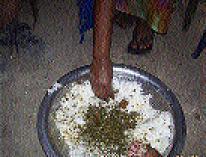
In Sierra Leone, it is customary that when dining a bowl is set for six or more people and everyone eats from it with their right hand. Here, people gather to eat cassava leaf and rice with granut sauce (peanut soup).
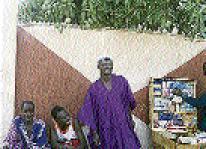
A group of men hang out at a stall in Waterloo Village near Free Town. Close to the city you will find stalls selling items such as cigarettes.
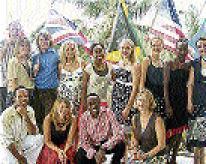
The group of students which recently completed their five-month Discipleship Training School in Jamaica at the Youth With A Mission campus in Montego Bay. They are from Jamaica, Canada, England, the island of Guam and the United States of America.
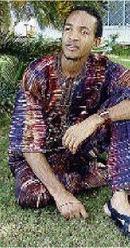
Teka Bailey wears a caftan, a gift from the Susu tribe in Sierra Leone. - Contributed photos