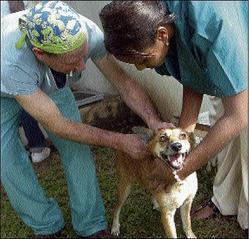
Dr Bruce Langlois injects Mitzy with anaesthetic prior to the surgery. Assisting Dr Langlois is Jenelle Irvin of Animalcare Veterinary Hospital. - Norman Grindley/acting photography editor
Dogs are said to be a man's best friend and can even be considered a family member in many instances. In some households they are given the best of treatment but, unfortunately, in others, they are scorned and abused.
It is not unusual to pass through a community and see litters of puppies on the streets or huddling around garbage bins. Many of these are malnourished and diseased.
But for organisations like the Jamaica Veterinary Medical Association (JVMA) and the international agency, Noah's Ark International Spay and Neuter group, treating canine ailments is all in a day's work.
The agencies got to work for two days, catering to the needs of dogs in some depressed areas of downtown Kingston. For two days, local veterinarians, their assistants and other volunteers worked alongside Dr Bruce Langlois from Michigan, USA to help to lessen the cases of overpopulation of dogs in these areas.
The dogs, some handed over by their owners or some just simply taken from the streets, were transported to two veterinary offices to be spayed (females) and neutered (males). The dogs, before admission into the programme, were preassigned, checked and examined.
On the first day, some 30 dogs were taken to Phoenix Veterinary, where they got spayed and neutered then brought back to their respective homes. And it was déjà vu on Tuesday when other dogs were given the same treatment at the Animalcare Veterinary Hospital.
Paul Cadogan, secretary of the JVMA, says this project, which is in its first year, was aimed at giving back to communities. He says it was also beneficial for owners who couldn't afford the general costs of taking their pets to the vet as well as to lessen the problem of overbreeding. "Overbreeding of dogs is a problem especially in inner-city areas, and this can lead to neglect and possible death. There are also people who can't afford to take their dogs to the vet and then resort to giving them human contraceptive, which can do damage."
Before the procedure, dogs were given a bath, dewormed, shaved and prepped for the surgery. They were also given anaesthetic and one by one they were taken to the surgery room, where Dr Langlois conducted the procedure with the assistance of other local vets. Dr Cadogan says while it is a charity event, local vets used the opportunity to learn new techniques from the foreign vet. "Dr Langlois uses a rapid spay and neuter technique, completing the surgery in about 10-12 minutes, so we, as local vets, can learn the process too."
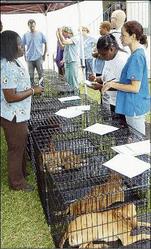
On site at the veterinary clinic, dogs were housed in a 'doggy' cage until it was their turn for surgery. Some were quite 'outspoken', barking at anyone who came close to their cage, and some very timid and scared. At the end of the day, all dogs were returned to their respective homes with owners not having to worry about unwanted puppies. It was however, not only about neutering or spaying, but addressing other illnesses that were in need of treatment.
latoya.grindley@gleanerjm.com
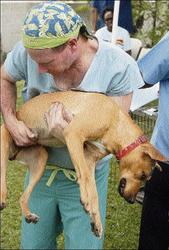
Dr Bruce Langlois, a veterinarian based in Michigan, takes Kiki to the operating room for her to be spayed, at the Animalcare Veterinary Hospital. She was sedated minutes before.
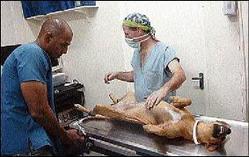
Dr Bruce Langlois (right) and Dr Paul Cadogan, secretary of the Jamaica Veterinary Medical Association, get ready to operate on nine-month-old Kiki. They are inside the operating theatre at the Animalcare Veterinary Hospital.
The dogs in their temporary homes, awaiting their turn to be spayed or neutered. Each dog had a medical file sheet placed on top of its cage for use by the veterinarians.