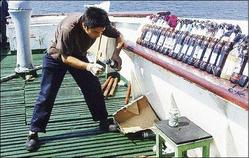
A Chinese crew member ignites a fire bomb to defend pirates' attack on the deck of the Chinese ship 'Zhenhua 4' in the Gulf of Aden, on December 17
WASHINGTON, DC (AP):
The Bush administration inherited a mess in strategic Somalia and may be leaving President-elect Barack Obama with a worse one.
The explosion of piracy off Somalia's coast is an attention-grabbing product of internal chaos in the Horn of Africa country, and a problem that will outlast the administration's success this past week in winning United Nations backing for possible pirate-hunting raids on Somali territory.
"We have a framework in place now to deal with this issue, but it's not going to be a very easy one," United States' State Department spokesman Robert Wood said.
Wood meant that there is more to do to combat piracy and, indeed, Somali gunmen seized two more ships the day the Security Council voted unanimously to authorise nations to conduct land and air attacks on pirate bases on Somalia's coast.
Bandits are taking over more and larger ships and ranging farther from land to do it. Last month, they seized a Saudi oil tanker carrying US$100 million worth of crude.
Making the country work
The larger problem, however, is the hollowness of nearly every institution that makes a working country, despite more than 15 years of international help.
The Somali pirates may be bandits and thugs, but they also are entrepreneurs making do in a place without a functioning government, laws or normal commerce.
"Once peace and normalcy have returned to Somalia, we believe that economic development can return to Somalia," Secretary of State Condoleezza Rice said, following the UN vote.
In the meantime, however, she wants a pirate crackdown.
"This current response is a good start."
The resolution sets up the possibility of increased American military action in Somalia, which has not had an effective government since 1991, when warlords overthrew a dictatorship and then turned on one another.
At Dangerous crossroads
A US peacekeeping mission in 1992-93 ended with a humiliating withdrawal of troops after a deadly clash in Mogadishu, the capital, as portrayed in the movie Black Hawk Down. A massive UN humanitarian programme withered.
The country is now at a dangerous crossroads. Ethiopia, which has been protecting the ineffectual and fractured Somali government, recently announced it would withdraw its troops by the end of this month. That will leave the Western-backed government vulnerable to Islamic insurgents and further chaos.
Joint Chiefs of Staff Chairman Admiral Mike Mullen singled out Somalia as a danger zone during a recent Pentagon news conference.
"I try to pay a lot of attention to the evolution of potential safe havens" for terrorism, Mullen said. "We need to do all we can to impede the arrival of more safe havens out of which we can be threatened."
The US accuses the most powerful Islamic faction, al-Shabab, of harbouring the al-Qaida-linked terrorists who blew up the US embassies in Kenya and Tanzania in 1998. Many of the insurgency's senior figures are Islamic radicals; some are on the State Department's list of wanted terrorists.
Spend money
To address Somalia's underlying problems, the US and the rest of the world would have to spend money building or rebuilding basic services and structures and encourage charities, development organisations and the Somalis themselves to do the same.
The Obama team should also ditch the myopic view of Somalia as little more than a hatchery for Islamic terrorism, said J. Anthony Holmes, head of the Africa programme at the Council on Foreign Relations in New York and a former top Africa official at the State Department.
He was working there when terrorists trained in what had become a terrorist haven in Afghanistan struck the US on September 11, 2001.
"There was a very serious concern that Somalia could be the next Afghanistan, and we've been reacting to that possibility ever since, but only in the most short-term respect," Holmes said. "We've been trying to kill terrorists rather than to facilitate the rebuilding of a state that would be inhospitable to terrorists."
At the least, Muslim Somalia represents a missed opportunity for a Bush administration that made a special project of promoting democratic ideals and good governance in the Muslim world.
Suffering civilians
Somali civilians have suffered most from the violence surrounding the insurgency, with thousands killed or maimed by mortar shells, machine-gun crossfire and grenades. An estimated one million people have been forced from their homes.
The UN says there are 300,000 acutely malnourished children in Somalia, but attacks and kidnappings of aid workers have shut down many humanitarian projects.
A support economy has grown up in port towns flush with ransom cash. Pirates have made an estimated US$30 million hijacking ships for ransom this year, seizing 40 vessels off Somalia's 1,880-mile (3,025-kilometre) coastline.
There are three NATO and Russian vessels and up to 15 other warships from a multinational force patrolling the area, along with a number of US Navy ships.
China said it plans to send ships to join the effort. Just recently, a Chinese cargo ship's crew aided by an international anti-piracy force fought off an attempted hijacking in the Gulf of Aden using Molotov cocktails and water hoses.
Last Saturday, Iranian state radio reported that Tehran had sent a warship to the coast of Somalia to protect its cargo ships against piracy. Since July, two Iranian cargo ships have been hijacked.
The commander of the US Navy's 5th Fleet has expressed doubt about the wisdom of pursuing the pirates on to land.
Vice-Admiral Bill Gortney told reporters it is difficult to identify pirates, and said the potential for killing innocent civilians "cannot be overestimated".
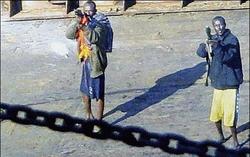
In this photo released by China's Xinhua News Agency, pirates aim weapons on the deck of the Chinese ship 'Zhenhua 4' in the Gulf of Aden, on Wednesday, December 17. According to Xinhua, the ship escaped pirate hijack after the crew fought for four hours with the help of a multi-coalition force and no injuries or deaths were reported. Nine pirates armed with rocket launchers and heavy machine guns boarded the ship then the 30 crew members locked themselves in their accommodation area, using fire hydrants and firebombs to prevent the attackers from entering, said an official with China Maritime Search and Rescue Center - AP Photos