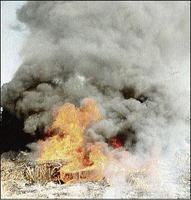
A fire burns in an open lot near Spanish Town Road in St Andrew yesterday. Residents of 'Staths' Lane near Bumper Hall, off Spanish Town Road, started the blaze as they tried to clear a bushy area in their community as part of the Christmas clean-up programme. - Norman Grindley/acting photography editor
THE FIRE department is imploring persons involved in Christmas clean-ups not to dispose of their garbage by burning.
Yesterday, residents of 'Staths' Lane, off Spanish Town Road in southwest St Andrew, started a massive blaze as they tried to clear a bushy area in their community as part of the Christmas clean-up programme.
"They have not given us any tractors or heavy-duty equip-ment, so we have had to try to use tyres to burn out the heavy bush," a resident told The Gleaner.
Public-health risk
But as the thick, black smoke billowed over nearby com-munities, including Denham Town, Bumper Hall, Rema and Tivoli Gardens, public relations officer at the Jamaica Fire Service, Emilo Ebanks, urged other Jamaicans not to follow suit.
"Apart from the damage to the environment and the public-health risk, the fire could easily get out of hand and damage adjoining properties and cost lives," Ebanks said.
The Public Health Act also addresses the burning of garbage and persons who violate nuisance regulations stipulated in the act risk prosecution and a penalty of $50,000 or 12 months' imprisonment upon conviction.
Contamination
It has been scientifically proven that when garbage is burnt in a stove, barrel or open camp fire, it creates poisons in the form of a large variety of toxic chemicals that are released into the air.
These fall back to the Earth as particles or in raindrops, contaminate the water, plants and soil, and accumulate in the fat of animals and fish.
People who are exposed to these air pollutants can experience eye and nose irritation, breathing difficulty, coughing and headaches.
Persons with heart disease, asthma or other respiratory diseases are especially sensitive to air pollutants.