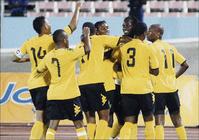
Jamaican players celebrate one of the two goals scored against Guadeloupe in their Digicel Caribbean Cup semi-final on Thursday night. The hosts won 2-0 to advance to tomorrow's final. - Ricardo Makyn/Staff Photographer
VERY FEW people, probably even some among their group, thought Anthony Modeste and his band of Grenadian 'ballers could have made it to the Digicel Caribbean Championship final eight, let alone play in the tournament decider.
The tiny east Caribbean nation shocked regional powerhouses Trinidad and Tobago, the lone Caribbean country remaining in CONCACAF World Cup qualifying, 2-1 dispatched Barbados 4-2, then eliminated highly-rated Cuba on penalties in Thursday's semi-final, to set up a showdown with hosts Jamaica.
Even Antigua and Barbuda, one-time fodder for the mighty, left their mark by drawing with semi-finalists Guadeloupe and last year's champion team, Haiti.
If anything, their advancement is a measure of the growth of the sport in the region, reflecting how much the one-time minnows have finally come of age. The sentiments have been mentioned from an interesting corner, that of Jamaica, who may be resting rather confidently, or uncomfortably, ahead of their impending showdown against opponents they already blasted 4-0, but have nothing to lose.
As one of four regional teams to have qualified for the World Cup Finals, and with a battery of players who compete in big leagues, Jamaica were very deflated coming into this Digicel Championship because of World Cup elimination.
All-round improvements
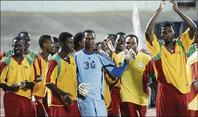
Grenada players celebrate their semi-final victory over Cuba on Thursday night at the National Stadium. Grenada's victory showed a growing parity in football in the region. - Ricardo Makyn/Staff Photographer
However, John Barnes, who officially began holding the reins in competition as Reggae Boyz head coach in this series, notes all-round improvements at this level and noted it is dangerous to view this campaign as a letdown.
"You have to play every time you are called upon. You have to perform when you are called upon and it would have been fantastic if we were called upon to perform in the World Cup qualifiers but we are not, so the next test is the Caribbean Championship," Barnes pointed out at team-training this week.
"So, therefore, you cannot pick and choose when you perform. Are we now supposed to feel that this is beneath us and this is a lesser competition? No. Because for us to get the consistency, we need to progress in future World Cup qualifications and matches we have to approach every match the same way, have the same attitude, the same desire, whether it's a World Cup qualifying match or a Digicel match against Barbados or Grenada," he said.
"I've been pleased with the way the players have responded because they have shown the same desire and will in those matches as they did against Canada, Honduras and Mexico (in World Cup qualifying). The next thing is to try and win the Digicel Cup. Getting to the semi-finals means qualifying for the Gold Cup but we can't rest on our laurels and be happy with that. We have to try and win the competition," he said.
Tyrone Marshall, the Jamaica captain, also noted the strides made by smaller Caribbean teams over the years.
"I think it's come a long way. Looking in the stands, you see coaches from the MLS (Major League Soccer) and all over. Scouts are coming down because they know we have talent in the Caribbean, so it's definitely come of age," Marshall said.
"We have improved leaps and bounds from where we are coming from," Marshall stated. "There's definitely talent here in the Caribbean and talent in this competition and I know guys are going to be signing contracts after this.
Public education
"We just have to make sure that we go out and take care of our business in the play-offs."
Barnes, who was born here and went to St George's College until he migrated to England in his teen years, has spent a fair bit of time trying to get his players to understand that.
Call it public education but he is equally fervent in the belief that the people of the country need to wake up to the reality of the Caribbean's football transition, so that they won't pressure the team unnecessarily.
"Caribbean football is much more competitive than it ever has been and the quicker we recognise that the quicker we can move forward, the quicker the bigger teams can move forward because the more we disenfranchise the Barbados team and the Antigua team and the Guadeloupe team, the more that we feel we should be beating them and we don't, as Trinidad and Haiti haven't, the more it's all doom and gloom in those countries," reasoned Barnes.
"But, if we recognise that these teams can be competitive and we respect them and feel that yes, we may be better than them, but we have to approach them in the right manner, not just from a playing point of view, but from the country's point of view.
"We have to recognise that all the matches here are difficult, pay respect to the other countries and then we can support the players, even in times when we have only beaten Barbados 2-1, rather than think 'we should have beaten them six'.
"Then we get behind them and say it's a difficult match, we showed the right character to come back and win a difficult match. So, let's stay with them rather than coming down too hard on them because they didn't beat Barbados 6-0."
Typical case in point was Thursday night's semi-final against Guadeloupe when Jamaica took an early lead through Oneil Thompson's 11th-minute header and played a high-possession game as the opponents played nine men behind the ball and sat back deep in defence.
The crowd got restless and started booing, even as Jamaica were comfortably controlling the game from an advantageous position which didn't require taking risks.
"The fans started booing a bit when we were 1-0 up and keeping the ball. We have to be patient when we are 1-0 up," stressed Barnes, who won two English Premier League titles at Liverpool.
"The only difference between this game (Guadeloupe) and the Barbados game is Barbados played the same way, but we went 1-0 down against Barbados which made it difficult for us.
"The management of the game against Barbados was that we were 1-0 down so we couldn't keep the ball at the back, we had to do something different."
Contrasting strategy
For the Guadeloupe encounter though, Barnes pointed to the contrasting strategy that was required.
"If we had to keep the ball for the next 45 minutes in the second half and not go forward and win 1-0, I'd have been happy.
"When we are 1-0 up we have to be patient because eventually, as you saw in the second half, they then had to come out and when they came out we picked them off with two or three passes where Luton (Shelton) went through to score, Dane (Richards) went through one or two times, so we have to be patient."
Jamaica won the Barbados game 2-1 and eventually downed Guadeloupe 2-0. Barnes, pointing to his small-framed front-men, stated the advantages of coordinating grounded build-ups using relatively short passes rather than hitting the balls long and high.
"Our strength is not hitting long passes up to them because Luton (Shelton) is not big or strong to take them on his chest and neither is Dane nor Andy (Williams). We got frustrated and started hitting the balls long and giving it away and that's what I mean by game management," he said.
Besides understanding, more than anything else, it is the composure of his players in managing such game situations that will ultimately dictate Jamaica's success in putting away a Grenada team and shows just how much Caribbean football has come of age.