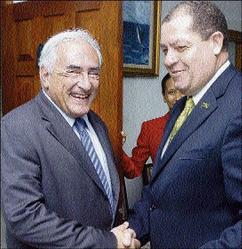
Domique Strauss-Khan, managing director of the International Monetary Fund (IMF) is greeted by Audley Shaw, minister of finance and the public service, during a courtesy call at Shaw's National Heroes Circle offices in Kingston on Tuesday. The IMF chief is on an official visit to Jamaica. The two men will host a joint press conference today and Strauss-Khan will also be keynote speaker at the Private Sector Organisation of Jamaica luncheon at the Hilton KIngston hotel. - Ricardo Makyn/Staff Photographer.
Audley Shaw, the finance minister, expects multilateral lending agencies to pump over US$1 billion into Jamaica by the end of the financial year in March, and says the projected inflows will help to cushion any fall-out faced by the island from the global credit crisis.
Shaw also hailed the loans as a success of his efforts at re-engagement of the multilateral banks, which he and others in Bruce Golding's administration have argued were neglected by the former People's National Party (PNP) government.
"We have had our problems but, through to the end of this fiscal year, to see a total infusion into the system of over US$1 billion, is not chicken feed money," Shaw told a forum at the Technology Innovation Centre (TIC), a business incubator at the University of Technology's (UTech).
Stabilisation programme
"It (the inflow) is going to be very important in our stabilisation programme," Shaw said.
Shaw's sum includes US$200 million that First Caribbean International Bank (FCIB), the Barbados-based subsidiary of Canadian Imperial Bank of Commerce (CIBC) is borrowing from the Inter-American Development (IDB) for on-lending to the private sector.
It was not immediately clear, however, how much of the FCIB funds will be available to firms in Jamaica.
The rest of the billion dollars is made up of:
US$300 million that has already been secured by the Government from the IDB;
US$401 million - in two loans - now being negotiated with the IDB;
US$100 million for which Jamaica is in talks with the World Bank; and
US$50 million for which negotiations are being finalised with the Caribbean Development Bank (CDB).
These are mostly policy-based loans, in exchange for which the government will have to undertake agreed policy changes.
Downgrades
Jamaica, earlier this year, raised approximately US$300 million on the global financial markets to plug gaps in the Government's budget and had planned to go back for another US$250 million before the March 30, 2009 close of the financial year. Part of this cash would clear matu-ring Government bonds.
However, the fallout from the meltdown of several global banks, as well as downgrades, or threat of downgrades of Jamaican instruments by rating agencies, makes a debt foray into the private markets by Kingston problematic, experts say.
But, Shaw suggested that the administration has acted strategically to head off the worst impact of the crisis.
"This global adversity that we face now puts us in a position where either we decide we are overwhelmed by this adversity or we are going to systematically look and see how we can carve out opportunities from the adversities that we face," he said.
In fact, borrowing from the multilateral, he pointed out, was a platform fashioned by the Jamaica LabourParty before it returned to power 15 months ago. It had shown results in a year.
Already, some of the multilateral cash has provided liquidity support for Jamaican banks and brokerage houses. These institutions were stressed by margin calls from foreign counterparts when the price of Jamaican Government bonds, put as collateral for debt, began to collapse in the face of the global credit crisis.

This demand for foreign exchange helped trigger a rapid decline in the value of the Jamaican dollar, which has slipped by more than six per cent in two months.
The Bank of Jamaica earmarked US$300 million for its liquidity support initiative, but said Shaw: "So far I am happy to say that only US$170 million has in fact been taken up."
His upbeat stance, notwith-standing, Shaw said that the Jamaican economy had deep structural problems and social difficulties, which inhibited growth.
"The problem of crime that we face today are problems that have been coming at us for many, many years in the making to the point now where crime and corruption virtually have become, as undesirable as it is, somewhat cultural," he said.
Low labour productivity and over-dependence on foreign goods and services were other inhibitors to economic expansion, Shaw argued.
Said he: "Long before the implosion on the global economic landscape we have had our implosion here. We have had our financial sector collapse in the middle of the 1990s when more than 40 financial institutions closed their doors in Jamaica.
"We have had in that period, as well, an aggressive demise of what I refer to as the productive sector, especially the goods-producing side... So, all of this has led to the tremendous debt burden that we have in the country...."
For Jamaica to return to a path of economic growth, Shaw said the country would have to rebuild its productive and creative capacity, of which incubation programme administered by the TIC was part of the process
The TIC is the technical division of UTech which supports the growth and development of early stage, technology-oriented businesses.
Through its Business Incubator programme, the TIC assists businesses to become established and profitable by providing technical advice and access to funding in the development phase.
john.myers@gleanerjm.com