
Enrico Stennett - Contributor
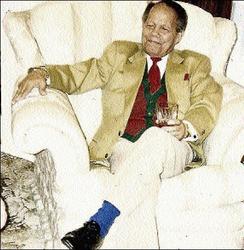
This is the final of a three-part story of the fascinating life of Enrico Stennett, a half-black Jamaican, who was brought up on his white mother's relatives' properties in St James.
Thirteen-year-old Enrico was stolen from Maroon Town, St James, by two older cousins, Edna and Gertrude, and taken to Kingston. Upon his arrival he was told by Edna of a white British couple, Mr and Mrs Johnson, who were interested in adopting him.
When he was taken to the couple's posh home on Lyndhurst Road, he, who considered himself the privileged buckra massa pickney, and was partly raised by servants, was now suddenly a servant himself. Cleaning 12 pairs of dirty shoes was his first task. After that, he was ordered to polish the silver cutlery, presented to him in a big box.
Leftovers
When it was dinner time, the now very hungry Enrico watched as the Johnsons and their guests ate heartily. After they were finished, the housekeeper gave him the leftovers. The shocked Enrico looked at her and said, "Who do you think I am? I have never eaten anyone's leftovers in my life, and I am not going to do so now. Please take it away".
After complaining to Mrs Johnson, the housekeeper was instructed to give Enrico some chicken that was in the fridge for three days.
Enrico: "On hearing that the food had been there for three days, I thought there was no way I could have eaten it. I went to bed hungry that night, sleeping in the servants' quarters."
The following morning, after a breakfast of cornmeal porridge, he accompanied Mrs Johnson to the market. He followed her around with the basket that was getting heavier with each purchase. But Enrico noticed some boys pushing carts with people's goods. He stopped one of them and said, "Please carry this lady's basket". Mrs Johnson was livid.
Enrico: "I told her I was not her servant, I had not come there to be one, and I wanted to return home now, to Cousin Edna. She stopped her shopping and hurriedly took me back to her home ... I waited while she phoned Mr Johnson and he returned home immediately, put me into his car and returned me to Cousin Edna."
Needless to say, Cousin Edna was "ashamed and angry" because Enrico was "rude" to these "good people and they so wanted a nice boy". And, then the beatings, which he had been getting all his life, started again. Edna, who could not afford to look after Enrico, "continuously bullied him" and kept him from school. He spent his days swimming in Kingston Harbour, only going home when he was hungry.
Yet, it was his acquaintance with "Sugar", a girl living near him, that drew Edna's strongest ire. You see, Sugar was very black, and Edna heard that Enrico was walking all over the place with her one day. When he arrived home, Edna confronted him. Enrico replied, "She is just a friend who lives in the ice shop". Edna reacted violently.
Enrico: "So I was kicked down two flights of stairs, suffered cuts and bruises, and was caught and beaten severely. I was told I had been beaten, not because I was walking with a girl, but because she was as black as the ace of spade and not fit to be my servant, and that I should not be seen with her anymore."
Eventually, Enrico enrolled at Calabar School, run by nuns, who gave him some "interesting" lessons. He grew up in a changing Jamaican society, when American culture started its invasion, and when mostly Europe was going through the second World War. Jamaica was not directly involved in the war, but it affected life on the island. Many young men wanted to leave to fight for Britain.
Not white enough
They tried the legal routes, but most were rejected because, according to Enrico, they were not old, white, or educated enough. Stowaways on merchant ships thus became the order of the day. Kingston, which was a port for sheltering British ships and from which food was exported to Britain by the shiploads, was overrun by sailors and brothels.
Enrico met some more of his relatives, almost died from malaria, which he contracted in St Thomas, and became deeply involved in the labour movement and politics of the day. He eventually got disillusioned with the state of affairs in the country. When the war ended around 1944-45, he was adamant about going to England, but was dissuaded by his relatives, who could not afford the passage anyway. He met a young man who shared his desire and they "were determined that (they) would leave Jamaica at all costs".
Enrico: "Each day, as I sat on the harbour and gazed out to sea, I could only see England through my eyes, thinking of the land of milk and honey, the land where the streets were paved with gold ... the land my ancestors so proudly talked about ... the land I had been told I was a part of and where the people were Christian and good people. Now my only goal in life was to reach this land."
To reach that land stowing away seemed to be the best opportunity. So, late one night he and his friend scaled a huge ship and hid in a lifeboat, thinking the ship was going to England. After three days of hiding and upon discovering that the ship was an oil tanker on its way to Curacao, the hungry stowaways gave themselves up. They were put to work scrubbing the deck and painting the ship by the angry captain. After two days of touring Curacao they were put on a KLM aeroplane to Jamaica, where they had to walk from the airport at Palisadoes to west Kingston.
Unable to speak Spanish
That same night they entered another ship, hiding again in a lifeboat, and arriving some weeks later in Tampico, Mexico. Unable to speak Spanish, they gave up and were put on another ship back to Jamaica. Upon arriving, they were detained and taken to court the following morning, appearing before Chief Magistrate Essa, who sent them straight to juvenile prison, Enrico for 30 days, and his friend for 14.
Very upset with Essa for sending him to prison, Enrico went to Essa's "palatial home" on South Camp Road, to speak his mind, when he was released with his friend after 14 days. Some weeks later, with "enough food and drink", Enrico and his crony boarded the SS Gascony, a cargo ship, and hid among sacks of sugar. After two weeks at sea, when they gave themselves up, the furious captain threatened to throw them overboard, but instead put them into a boat, which took them to another ship on its way to Jamaica.
Undaunted by their stowaway failures, the young men kept their faith. In 1947, when the SS Empire Windrush brought about 500 ex-servicemen to Jamaica, Enrico, his friend and a half-Chinese youth got onboard. When they were discovered, the captain, a rather pleasant man, gave them work and treated them well.
Enrico: "On reaching Southampton (southern England), we were handed over to the police ... the captain recommended that we should not be punished ... (But) little did I know the horror I was to go through in my first three years, with rejection by my second mother, the mother country."
paul.williams@gleanerjm.com