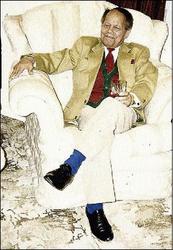
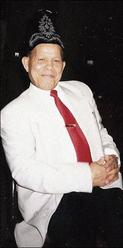
Enrico Stennett - Contributed
This is the second of a three-part story of the fascinating life of Enrico Stennett, a half-black Jamaican who was brought up on his white mother's relatives' properties in St James, and who stowed away to Britain, where racism, which he also encountered in Jamaica, shattered his 'street-of-gold' image of the motherland, and where he was a trade unionist and leading agitator for the rights of black people in Britain.
At age 12, Enrico met his mother for the first time, in Maroon Town. She lived in abject poverty, being disinherited for her romantic involvement with black men. She despised Enrico, who left her to live with an aunt. Longing for the privileged education and life he had in Mount Carey, Enrico left Maroon Town one day without telling anyone, and got lost. After surviving on fruits and sugar cane for two weeks, he came upon a hut occupied by a tall, black woman.
Enrico: "This lady took one look at me and, with a shocked expression on her face shouted, 'Coya, look at buckra massa pickney, come here buckra massa pickney, what are you doing in this bush? Look at you so dirty, and your clothes tear up'."
The woman took off his clothes, washed, mended and pressed them. Enrico was fed and given directions to Mount Carey. However, he was surprised that her three children were wearing dirty and torn clothes, and it seemed to be okay.
Following her instructions, he stumbled upon a small village with shops. He stopped at one of the shops to ask directions, but the owner of the shop asked him to stay. He did, only to wake up the following day to be the exotic centre of attention in the village.
Enrico: "It was quite obvious they had never seen anyone like me in the village before; the people were curious about where I came from, and who I was. I was then put to work behind the counter where I helped serve the groceries. People were coming to the shop out of sheer curiosity to talk to me."
After two weeks at the shop, a preacher man came by and saw him reading a Bible. The man got an idea. Since he couldn't read, he asked Enrico to go around with him reading the Bible, while he preached. Enrico was also asked to teach the Bible at the Sunday school in the village.
For four months, he was the darling of the village, adored wherever he went. His words were gospel, and he was invited to the homes of many families.
Christian belief
Enrico: "I began to feel like John the Baptist, preaching to the people of the village, and my Christian belief became stronger, to the extent I thought I would grow up to be a preacher myself."
All this while, his family in Maroon Town did not know where he was, and the yearnings to be back in Mount Carey were still strong. Yet, they were to be strong, unfilled yearnings, for one morning, about 4 a.m., while he was asleep at the preacher's house, he heard a loud voice say, "Henry, get up and go home!"
Enrico ignored the voice and went back to sleep, but it shouted again with a more powerful and demanding tone. He recognised it to be the voice of his great-uncle from Maroon Town, and became afraid. He got up, packed his belongs, and not wanting to wake up the preacher, silently left the house.
Under the shining moon, and to the sounds of roosters heralding the dawn, he left the village, back to Maroon Town, without knowing exactly where the road led. Alone and afraid, he remembered stories of duppies and rolling calves. Yet, he pressed on. He had to go.
Invisible hand
"I was guided by an invisible hand showing me the way that I should travel ... As the sun rose and the day became clearer, I became less fearful and my journey became less stressful ... suddenly about 10 a.m., I recognised just where I was. I was approaching my school in the village of Maldon, about four miles from Maroon Town, when I saw one of my family's lorries coming up the hill."
When the lorry reached him, the driver jumped out, and told him that everybody had been looking for him, and that his great-uncle, the one whose voice he had heard in his sleep, telling him to go home, had died in hospital at 4 a.m., the same time when he heard the voice. The driver was on his way to Montego Bay to collect the body. Enrico opted not to go with him. Another four miles, and he was at his great-uncle's home, where much mourning was going on.
No more Mount Carey
The following day was the funeral, and people from near and far went to pay their last respects. Enrico met relatives he did not know of and they him. There were two, cousins Gertrude and Edna, his great-uncle's daughters, who were particularly drawn to him. The crossing of their paths, unbeknown to Enrico, was to be the end of his childhood in St James, no more Aunt Matilda, no more Mount Carey.
Enrico: "On the night of the third day, when they were leaving for Kingston, my cousins Edna and Gertrude put me in the boot of their car so that no one would see them taking me; they stopped at Dundee Church where I was removed from the boot and put into the back seat to travel to Kingston. The journey took all night and I fell asleep in the car."
Adopted son
Three days after his arrival in Kingston, Edna told him they took him to Kingston for him to be the adopted son of a white British couple. "When Cousin Edna saw me in Maroon Town, saw the way I behaved and listened to the way I spoke, she believed I would be just the boy suitable for Mr and Mrs Johnson." But Cousin Edna's idea was misconceived, for she had absolutely no idea that the eloquent mixed-race cousin that she stole from Maroon Town was buckra massa pickney, who must be treated as such and as nothing less.
A few days later, Mr Johnson came to collect Enrico. He took him back to his opulent house on Lyndhurst Road, where he was introduced to Mrs Johnson and the servants. And, in a few minutes, buckra massa pickney's status suddenly changed.
Enrico: "Before I knew what was happening to me, I was taken straight to the servants' quarters and immediately put to work. They brought out about a dozen pairs of shoes and I was told to clean them. I was surprised because I had never had to clean my own, nor anyone else's shoes at any time in my life. Now these shoes were before me, with the brush, polish and cloth."
Next week, in the conclusion, buckra massa pickney would have none of it, and the motherland beckoned.
paul.williams@gleanerjm.com.