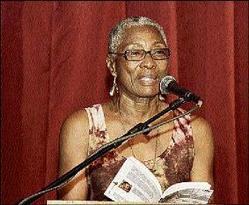
Dr Velma Pollard reads from her book, Leaving Traces at the simultaneous public presentation of the book - Leaving Traces and Dr Earl McKenzie's The Almond Tree, held at the Philip Sherlock Centre for the Creative Arts, UWI Mona last Sunday. - photos by Nathaniel Stewart/Freelance Photographer
Last Sunday morning, a combined wealth of talent, experience, insight and dedication to the art of writing was presented to a substantial audience at the Philip Sherlock Centre for the Creative Arts, UWI, Mona.
The combination came not only in the simultaneous public presentation of Dr. Velma Pollard's Leaving Traces and Dr Earl McKenzie's The Almond Tree, but the individual poetry collections themselves. There was a distinct lack of bombast, though, or pomp and pageantry to go with the poetry; the launch was as succinct as possible considering the depth of writers and their writing.
One perspective
After the department's head, Dr Anthea Morrison, welcomed all, Pollard's Leaving Traces was first up, Tanya Shirley giving her perspective on poems that are narrated by an older woman generally.
Shirley identified some of the physical places where the poems are located, including Puerto Rico, Italy and Montserrat, noting that she both records public events and gives the inner musings of someone who is privileged to be insider and outsider.
One of the events Pollard observed was the attack on New York, September 11, 2001, in While TV Towers Burn, Shirley saying Pollard emphatically described the event but also speaks to previous actions.
She tied in Pollard's focus on birds in the final section of Leaving Traces with her concerns about rebirth. "Your libraries will not be complete without this collection," Shirley ended.
"All of you who have never had a younger person read your stuff and arm to it - this is what is possible," Pollard said. "I am very grateful and humbled." She read 'While The Sap Flows' and 'View Through Her Window' for Olive Senior, before 'Portobello', which came out of her issues with Francis Drake. "I stand where Drake fell, Francis forever on my mind," Pollard read, changing tone for "dis one fe dead bad".
Montserrat Old Town came from a visit to the island "while the Vesuvius of the Antilles still smokes", War Child was about the Iraq War and Pollard closed with Messiah.
Honouring performances
Saxophonist Tafawee Buchsaecab delivered Redemption Song between speakers and Earl McKenzie would later include Musicians in his reading, honouring the performance.
Mervyn Morris did the analysis of McKenzie's The Almond Leaf, saying that McKenzie's varied talents and pursuits "often register the sensory detail of the natural world". However, the poems are carefully put together to extract meaning beyond the sensory. Morris said McKenzie pays tribute to music, from Bach to Coltrane, and comments on history, racism and terrorism, among other issues.
Wheels of War compares McKenzie running his wheel as a child with another child doing the same thing against the backdrop of war machinery on the move. Morris noted the specific reference to philosophy in Building a City and commented that "Earl writes some sexy love poems, such as Adam to His maker and Dream in Vancouver".
"What we encounter in poem after poem is an earned simplicity," Morris said, adding that McKenzie's discipline was evident throughout the collection, which he warmly recommends.
Jewel of tears
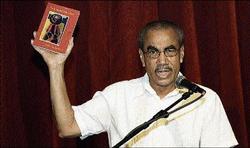
Dr Earl McKenzie raises a copy of his book The Almond Tree
There was laughter when McKenzie, before reading from 'The Almond Leaf', said "as a young aspiring poet, Mervyn was the first living poet I ever met". He started with Poet, for Morris, Edward Baugh and Wayne Brown ("this chronicler of pain has the jewel of tears in his eyes"), following with Call of the Mountain, from a period when he took some time off.
The title poem came from a visit to a staging of the Calabash International Literary Festival, then McKenzie switched gears to Girl In the Stacks, about a young woman ("her shorts hugged a figure that is the stuff of beauty pageants") who distracted a scholar in the library.
McKenzie said when Peace was first published in the newspaper someone called a talk show and read it. "I want a conscience as clear as Negril waters in the morning," McKenzie read.
There was Lines Written September 12, 2001' ("the hibiscus blooms in vain") and McKenzie also read The Bringer of Mangoes, Stranger Among the Tombs and the title poem from his next poetry collection, Basket.