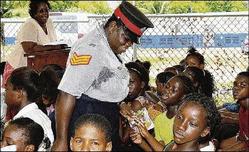
Sergeant Tomie Lee Chambers, who is responsible for community safety and security at the Elletson Road Police Station, is surrounded by children during singalong at a summer camp in August, hosted by the station. - file
Do you know the names of all the feelings you experience and what causes them to occur? Recently, a group of police officers went 'back to school' to learn how to deal with emotions and manage conflict.
These are policemen and policewomen who would later be used as school resource officers to reduce con-flicts in schools. But, first they had to learn to manage their own anger and situations of con-flict in their own families. The ses-sions saw them struggling and confronting these issues, sometimes tearfully, and when the sessions ended, wounds were healed and the journey began, to bring families together again.
The cops were then ready to go into the schools. They were equipped not with guns, but with the tools offered to them by the Peace and Love in Society (PALS) Jamaica Constabulary Force school resource officer training programme.
Anger a major problem
Janilee Abrikian, general manager of PALS and training coordinator, notes: "In the three sets of workshops done with the police, we had to spend an inordinate amount of time dealing with anger. They are a microcosm of the society. They brought to us dysfunctional families, abandonment and relationships which were not working. Unless we understand our own issues of anger and decide where we are going with them, we cannot help others. Their personal stories had people weeping when they shared them. We moved from the easy things to understand, such as what is passive anger, to the really difficult issue of dealing with the reality of the things that were making us angry. They learnt to drop the anger and then moved to forgive."
One officer said that he is now so good at psychoanalysing people and why they were experiencing the emotions exhibited, that this, itself, was causing him problems. Individuals often tend to hide their emotions and their causes.
This is what some of the police personnel had to say about the programme:
Constable Kohan Fuller, 28: The programme teaches one how to deal with conflict and how to be disciplined. It also teaches the value of different types of people. It teaches you how to handle your emotions and feelings.
It also teaches you to name feelings. Some people say 'I feel a way', but they do not know the different types of emotions and names. It was a very positive thing. Now I get along with people much better.
Corporal Sophia Duffus, 36: The training was really useful and effective. It really enlightens one in terms of problem-solving. The course has helped me in a million and one ways. In one case, a student and a teacher had an altercation because the teacher had pulled a rag from the back pocket of the child. The mother came to school the following day behaving boisterously, calling the teacher a homosexual. It was really bad. I was able to defuse the whole situation in two days.
Personally, in my everyday life, some of the things that would normally get me annoyed do not do so anymore. You are more calm and more mature in dealing with certain conflicts. My partner at home is happier. Some of the things (that once would) send you over the edge, you just smile instead.
Corporal Itilda Crawford-Bennett: I learnt a lot from the training. They taught us how to deal with conflict in schools and how you can reach students from volatile communities. You can rap with them. I use the conflict management styles all the while. It is the best course I have ever done. Sometimes, there are internal conflicts in my own personal life and I know how to deal with them. It helps in every way.
Next week: The change in some of the cops and PALS tells us how to manage anger.
Constable Richam Davis, 29: It has been very, very useful especially in the divisions in St James. We have some of the most volatile schools, in terms of community in which we are located. We have been implementing strategies and it is bearing fruit. We go on school visits daily and we are always presented with opportunities. We have been seeing results, slowly but surely. The training is also working in other areas of policing.
Personally, it has helped in the sense that immediately, as I am in a situation of conflict I begin to analyse the situation. Persons are complaining that I am analysing them too much. I need to make it less obvious that I am analysing the individual.
The training also shows me in the past, in my own life, where I could have dealt with situations better. It has had a lasting impact both personally and professionally
Next week: The change in some of the cops and PALS tells us how to manage anger.

POSITIVE Parenting