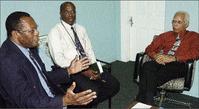
Dr Las Newman (left) president of the Caribbean Graduate School of Theology makes a point during an interview with The Gleaner recently. To his left are Dr Anthony Oliver (centre), academic dean; and John Keane, director of promotions and development.- Junior Dowie / Staff Photographer
After almost three decades as a front-line leader of evangelical students locally and internationally, Dr Lascelles (LAS) George Newman, has taken on the challenge of becoming president of the Caribbean Graduate School of Theology (CGST).
Theological engagement is however nothing new to him. He holds a Bachelor of Religious Education in Pastoral Ministry from the Ontario Bible College (now known as Tyndale University College). But his academic forte is as a church historian. He is easily among the top church historians in the Caribbean. He holds a Bachelor of Arts and Master of Arts degrees in History from the University of Waterloo.
His masters thesis earned honours for his dissertation on 'Calvin's Programme of Reform in the Reformation of Social Policy for Geneva, 1541-1555'.
Last year he completed his PhD at the Oxford Centre for Mission Studies, Oxford, England. His thesis was entitled, 'A Critical Analysis of West Indian Participation in the Western Missionary Enterprise in Western Africa in the 19th century, with special reference to their conception of mission'.
Since October, Newman has been working as the second president of the CGST. He succeeds Dr Dieumeme Noelliste, who resigned in July 2007. Newman will however be officially commissioned as president of the CGST in a service scheduled for November 22 at The Church of the Open Bible, Kingston, beginning at 4:00 pm.
CGST is the only graduate studies institution owned by the Caribbean Evangelical Theological Association. It is an institution with which he has had a relationship since 1991 as an adjunct lecturer. Prior to that he had been an adjunct lecturer Church History, Christian Apologetics, Christianity and Social Change, Politics and Culture in the Caribbean Basin, Church and Community Development at the Jamaica Theological Seminary (JTS), an institution which shares campus and facilities with CGST.
influential factors
Asked what were some of the factors that influenced him to accept his job, Newman said "I have developed a good sense of the strategic role that CGST plays in the evangelical constituency - serving the needs of the church. CGST has graduated over 400 students since its inception. The second reason I accepted it is that there is a good team in place and I am convinced that we can work together. I would not have accepted it if I was not convinced that there is a good team in place ... I look forward to working with the team."
He continued, "I am not a theologian. I am a historian. I come into the world of theology very carefully - with a historical perspective. So I agree that in terms of the academic menu, I might be able to make some contributions to the development of theological education," Newman said in an interview with The Gleaner.
An Anglican, Newman has been a member for many years of the St Andrew Parish Church. He brings to his new post a strong background in leadership and management. He is a former general secretary of the Students Christian Fellowship and Scripture Union (SCF-SU) in Jamaica; Regional Secretary, International Fellowship of Evangelical Students (IFES), (1995-2005). He was, until CGST came calling, based in England working as associate general secretary of IFES, and also its acting chief administrative officer. As associate general secretary of IFES he was the number two leader of this world evangelical students movement which spans 150 countries.
principal coordinator
He has also been chairman of the National Leadership Prayer Breakfast, and coordinator of the 1993 Luis Palau National Evangelistic Crusade. He was the principal coordinator for the first Anglican Congress of the Church in the Province of the West Indies, held at the Mona Campus of the University of the West Indies, in July, 2000. He was also a co-presenter of LOVE Television programme, Vantage Point.
Within the next few months, Newman will be focusing on a re-examination of the vision of the CGST; creating systems to preserve Christian heritage; augmenting course offerings that relate to the church's role in development; creating a space for an examination of various intellectual challenges to the witness of the church.
He said "Presently we are working on a vision document that would anticipate the fourth decade. In the first decade, we are focusing on: what should CGST be like, what should it look like. We want to have a process of renewal - a spiritual renewal in the community to look again at what God has called us to be and do. Also an academic renewal, which would expand the menu of courses".
"I am concerned about few things in the expansion of the menu. First, the loss of Christian heritage. The Church has been in the Caribbean for 500 years and has left behind some significant pieces of heritage that has been at the base of the fabric of our country. How can we recover that? It is the role of a theological institution to identify those pieces of our heritage that are distinctly religious."
"Second, how were Christian communities developed in Jamaica? There were Moravians, Anglicans, Baptists and others who developed certain communities. Out of these institutions came great institutions such as credit unions, building societies. I don't see much of this reflected in our understanding of our culture."
Third, in terms of curriculum development, he said "I want to see more research on the impact of the church in the community, and how the church can be a significant part of national development going forward. Where, for example, is the research to show the role of the church in trying to deal with the marginalised?"
challenges to be explored
Newman argued too that as Jamaica and other territories become increasingly secular, the church needs to address itself as to how it will do ministry in such an environment. These and similar intellectual challenges he said are there to be explored by CGST.
CGST, Newman said, should assist the church as it considers how it will fulfil its mission in the 21st century. In this regard he wants CGST to establish in the long term a Centre for the Study of Caribbean Christianity. He explained, "The Caribbean is dominated by Christianity and other religions as well. There isn't really a substantial study of Christianity in the Caribbean, including Caribbean theology. But also the influence of Christian thought and the Christian faith in all aspects of social life.
"... There has been half a millennium of Christianity in our region and yet we do not have any substantial documentation of the impact of Christianity - Protestant and Catholic on the region."
Another passionate goal for the new president is the augmenting of the capacity of the Zenas Gerig Library which serves both CGST and JTS. "One of those things that is very important for me is the role of the library. We are a graduate school and graduate school work means research. We want to strengthen the capacity of the library to deliver research.
"Another concern I have is the role of archiving. We have so many churches, so many denominations, so many religious institutions but where do we have the historical records? Where are the archives if people want to do research? Some of the key individuals who have really pioneered and helped with the establishment of the religious life of the country, where are those things archived and where are they housed. I think CGST can play a key role in being a centre for research and development for the Caribbean Church.
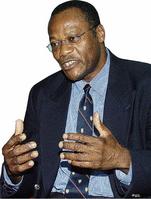
Newman
Newman, a former deputy headboy at Wolmer's Boys' School, hopes on his watch as president of CGST, to play a role in promoting the formation of a Caribbean Theology, an intellectual undertaking which peaked in the 1970s but which has fizzled. That endeavour, he believes, must necessarily include ideas to promote Caribbean transformation. He remarked, "Caribbean culture is being impacted by forces external to the region, which has influenced values attitudes and lifestyle. Where are the Caribbean theologians working on the transformation agenda - to show us what transformation should be and what kind of people we should become. I don't see it happening now on the Protestant front and the Catholic front.
CGST though domiciled in Jamaica, is seeking to establish centres in other Caribbean territories. There is the prospect, Newman said, that a CGST centre could be established in Trinidad and Tobago in the short-run.
Also, he said, the institution has an active online education programme which it hopes will be used by graduate students in the rest of the Caribbean and further afield.
CGST which offers five graduate degree programmes, including a Master in Business Administration (MBA), is pursuing university status.
"CGST has as part of its strategic aims, the establishment of Christian university status. It is an active part of the agenda of the board and the administration. I think the requirements are more or less in place. But from my point of view there are a few things that we need to do to strengthen the requirements that we need for university. In fact I would like to go beyond the criteria to start," said Newman.
Newman is married to Canadian-born Margaret Jane (nee DeJong) and they are the proud parents of daughters Minke, Anneke, and son Johnathan.
Send Feedback to mark.dawes@gleanerjm.com